


If you’ve been wondering how to play Sorare in 2026 (and 2027), I believe my Sorare guide is the best place to start. As an experienced manager with close to 5 years of playing the game every week, I’m in a pretty good position to help you avoid costly mistakes and become competitive right away.
The truth is that the game has evolved massively since its creation back in 2019. What we have today is vastly different from what the game was 7 years ago – or even a year ago!
The above applies especially to Sorare 27 – the newest rendition that launched in July 2026 and will last until the end of the European football season (May 2027).
But worry not – after reading this Sorare tutorial, you’ll be up to date with the current format and this will put you in a good position for both short and long-term success on the platform.
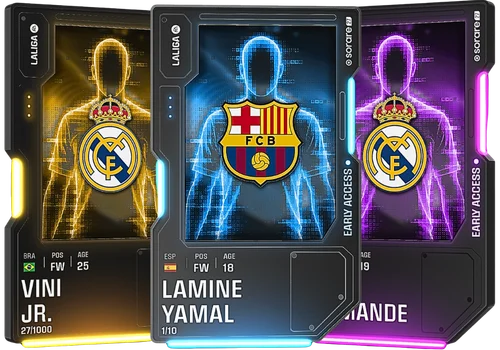
Join Sorare with code SORARECEO to get free $150 for your first cards.
SORARECEO
COPY
SorareCEO.com is a certified affiliate partner of Sorare. This is an exclusive bonus for my readers.
💡 In this Sorare guide, you will discover:
- What is Sorare and how does it work
- All game modes available in Sorare 27
- The biggest differences between Sorare 26 and Sorare 27
- Game mechanics such as scoring, card scarcities, types of competitions, Essence, XP, Vault
- Basic Sorare tips to help you play Sorare to make money or for fun (including the free-to-play mode)
📚 Contents:
- Introduction to Sorare
- How to start Sorare with free $150 credits
- Sorare 27 Game Modes Explained
- Explanation of the Scoring Matrix
- How to Scout Players?
- Composing Your Lineups
- The importance of Substitutions
- Card & Lineup Bonuses
- Beginner’s Guide to Card Scarcities
- Essence – the In-Game Currency
- Card Vault
- Buying, Selling & Trading Cards
Game Introduction. What is Sorare?

Before we move on to discussing to how the game works, it’s important to answer the most important question for beginners: what is Sorare?
The platform was founded in 2019 by two French football-mad engineers, Nicolas Julia and Adrien Montfort.
At a glance, Sorare looks like a fantasy football game mixed with trading cards. But once take a closer look, you realize it’s much more. It’s part strategy game, part football manager, part collectible economy. And it rewards skill, planning, and smart player scouting.
As someone who’s been in the game for so long, I’ve seen the company grow from a small niche experiment into a full-blown global fantasy ecosystem.
Because of the unique concept, licensed digital cards and attractive prizes, Sorare has been consistently growing its popularity all around the globe and continues to lure high-profile investors such as the arguable world’s best football player, Kylian Mbappe.

Each Sorare card is a digital asset. You can buy, sell, and trade them, just like real-world football stickers or baseball cards.
But here’s the twist: they’re usable. Every card you own can be entered into weekly fantasy contests. If your lineup does well, you win rewards (from tradable cards to cash to real-life sports experiences).
The game starts you out with a set of free Arcade (Common) cards so you can practice 100% risk-free, but if you want to compete in more advanced tournaments, you’ll need to get your hands on the rarer versions.
The aim of the game is to field the best possible selection of players out of your collection of player cards to reach point thresholds set by Sorare or score more points than your opponents. The better the players are, and the better they perform in real life, the more points you’ll score and the bigger your chance of claiming money or card rewards.
Now that we’ve got the introduction to the game out of the way, we can now move on to the Sorare guide proper.
How to start Sorare?

Before you buy your first Sorare card, you need to create an account. The registration process is pretty straightforward and quick.
You can register at Sorare by creating an account with your email address, Gmail account or your Apple ID. As a new user, you’re guaranteed an exclusive welcome bonus of $150 in credits to spend on the platform when you register with my partner link and code “SORARECEO“. You can do so instantly by clicking here – or read more about the Sorare promo code.
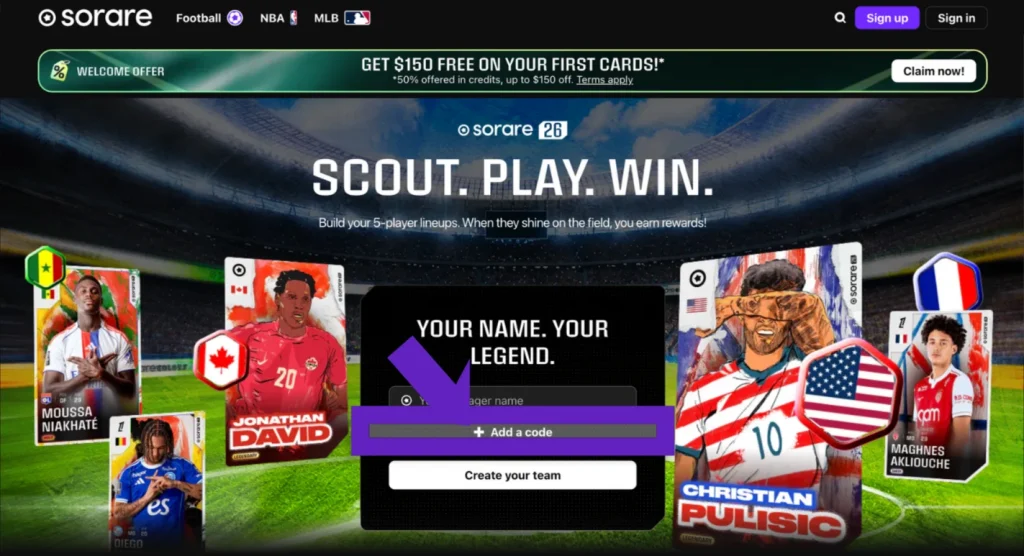
A screen similar to the one you see above should appear after clicking on the aforementioned link. Click the “+ Add a code” button I’ve highlighted for you in the screenshot above and copy my code from below.
SORARECEO
COPY
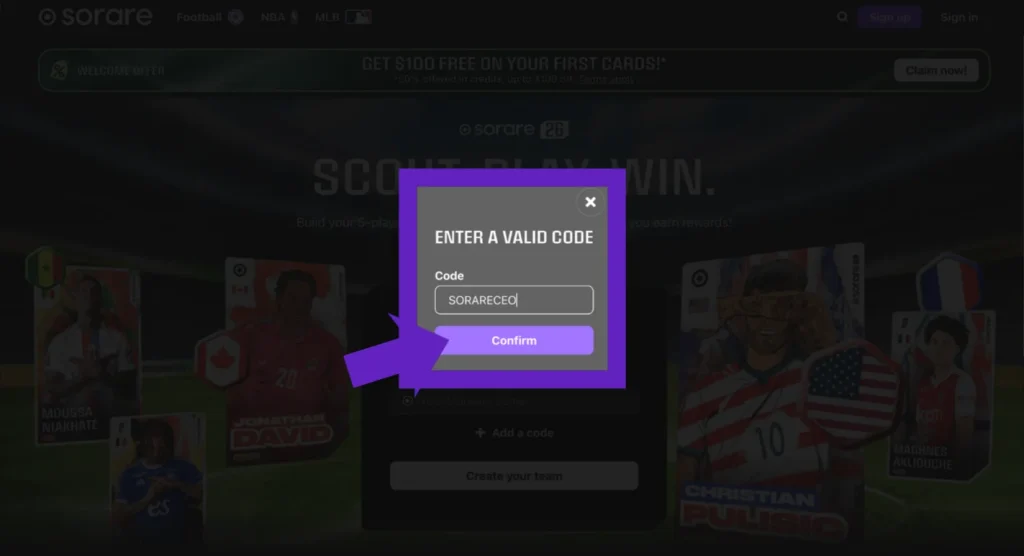
Now, paste the copied code in the box marked in the screenshot above and click “Confirm”.
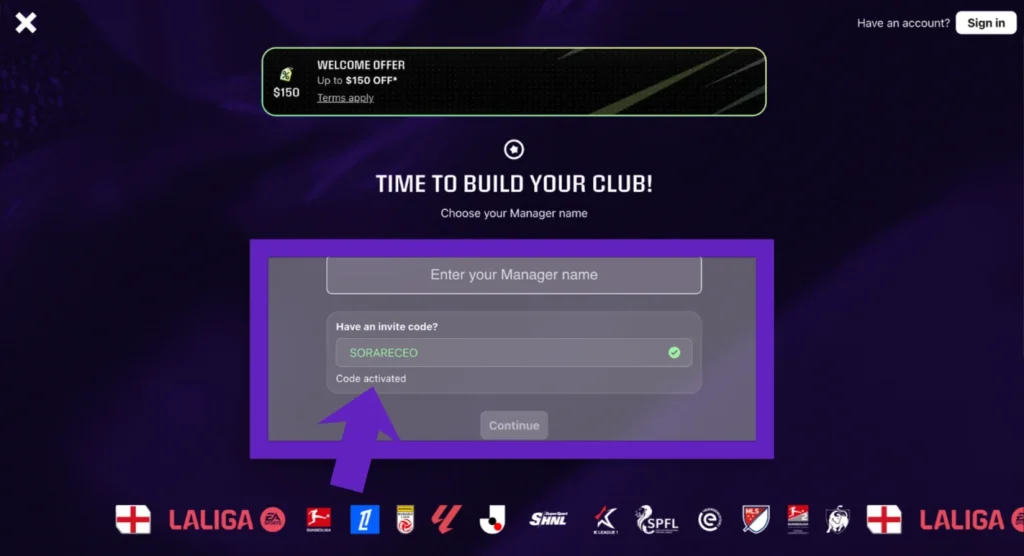
As you can see above, the code has been activated and you’re now ready to grab your free $150! 🙂
Now you should enter your desired manager name. This is what others will see when coming across your team on the leaderboards or trying to trade cards with you.
You can easily change the manager name after you register, so don’t stress out too much about it!

If your selected name is available, you’ll be directed to the next step (as seen in the image above) where you’ll need to:
- confirm you’re 16 years old or older (yes, there’s a minimum age requirement to play Sorare)
- agree to Sorare’s Terms & Conditions and Privacy Policy
- choose whether you want to register with an email, Google account, or Apple
💡 PRO TIP: if you’re reading this Sorare guide but already created an account without using the welcome offer, it’s not too late! You can simply create a new account with a different email address and be granted the $150 credit bonus offered exclusively to SorareCEO readers. It really gives you a big advantage when starting to build your gallery and also supports my content.
Make sure your password is strong enough, as you will be using it to log in to your account & access the marketplace.
Once you’re registered, you’ll be able to set up your profile (uploading an avatar and background image), as well as verify your email address and phone number. The verification process is important as it allows you to fully use the platform to buy, sell, or trade cards with other players.
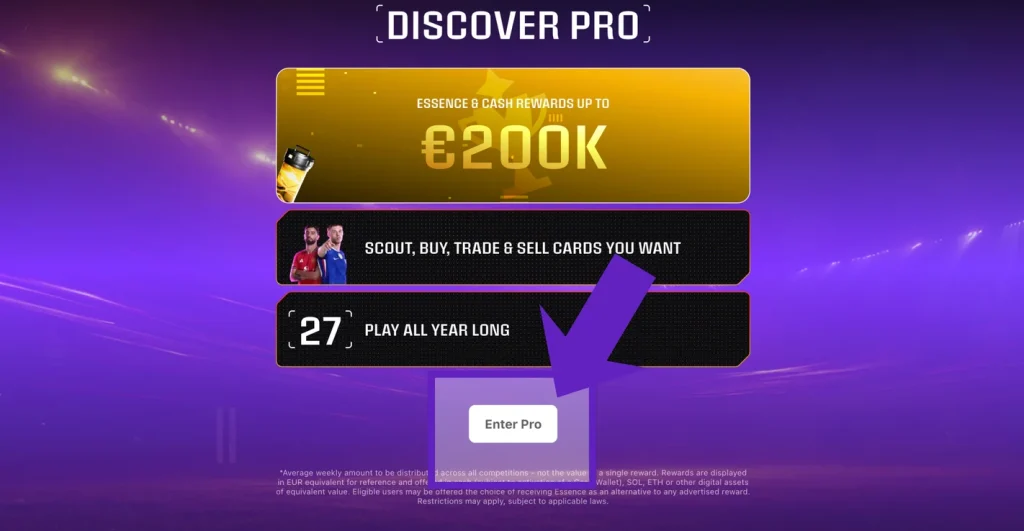
After confirming your email address, click the “Enter Pro” button shown in the screenshot above. This will launch the onboarding process.
The onboarding only takes about one or two minutes to complete. It walks you through the basics of Sorare with simple, beginner-friendly explanations, so you can get familiar with the platform before we start discussing all the details.
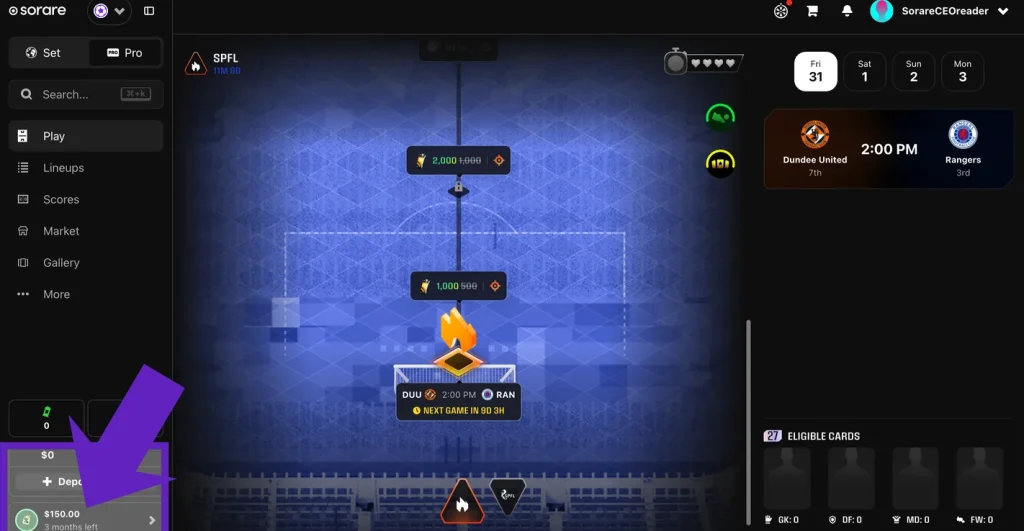
Once you’ve finished, you’ll arrive at the main Sorare dashboard. Your previously-promised $150 credits will already be waiting for you in the bottom left corner of the screen, exactly where they’re highlighted in the screenshot below.
First look inside Sorare
After verifying the account and logging in for the first time, you’ll land in the “home” section of Sorare. This is the place where everything starts – LITERALLY 🙂
Take a look at the image below.
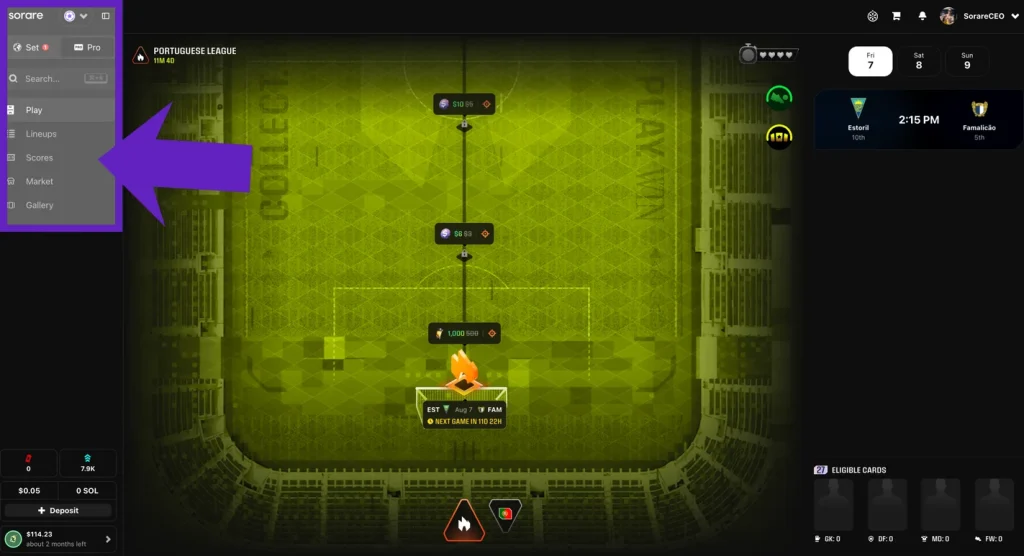
In the top left you’ll find quick links that allow you to:
- search for specific competitions, clubs, or players (“Search“)
- set up your lineups for the current and upcoming Game Weeks (“Play“)
- check all your past, current and future line-ups (“My Lineups“)
- check the results of all football matches as well as performances of the players (“Scores“)
- scout new players, create your own watch lists, buy new cards from Auctions & Instant Buys or second-hand cards from other managers (“Market“)
- browse your card gallery as it is right now, including individual cards, card collections and Vaulted cards (“My Cards“)
Now, see the image below.
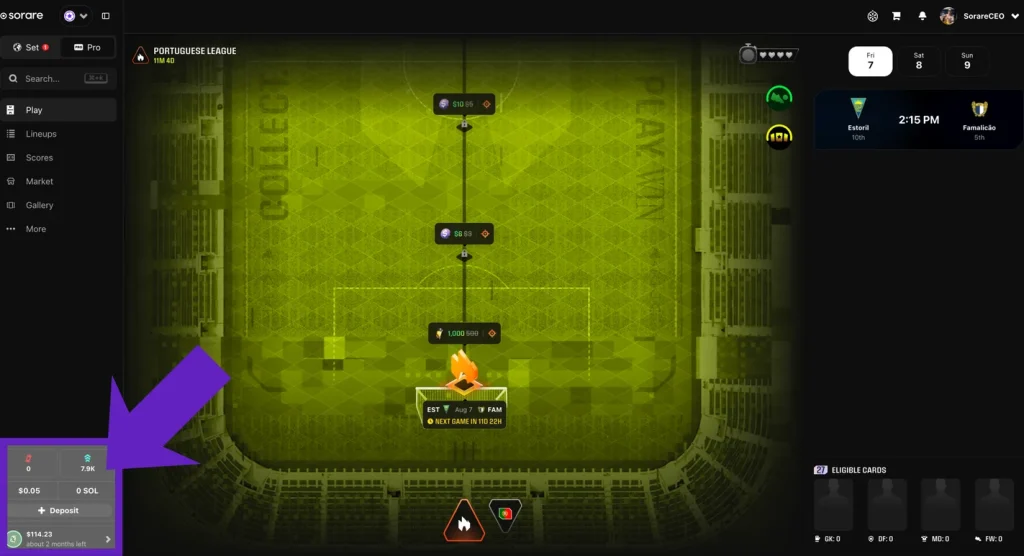
At the bottom there’s a quick summary of your bank balance, as well as a recap of your in-game items:
- Essence
- XP bonus reserve
- Gems
I’ll explain each of these later in this Sorare guide.
The middle section is a quick peek at the most fun part of the game – your progress!
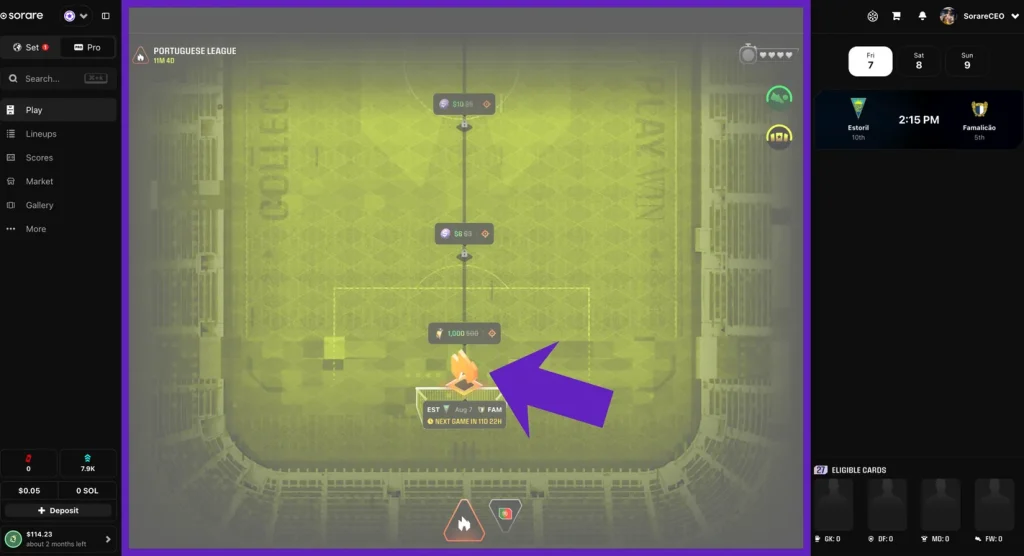
As you can see in the image above, in Sorare 27 this screen has been dedicated to arguably the most fun Pro game mode – the Hot Streaks (we will explain it in detail further down the article).
In that central part of the screen, you can easily see where you’re currently at on the Hot Streaks ladder, as well as have a peek at the rewards (both these yet to be won and these which you already claimed).
In the top right-hand corner of the Game Board, going from up to down, you can check:
- the number of attempts left in your current Streak
- today’s Decisive picker mission
- your progress in the Collect Missions
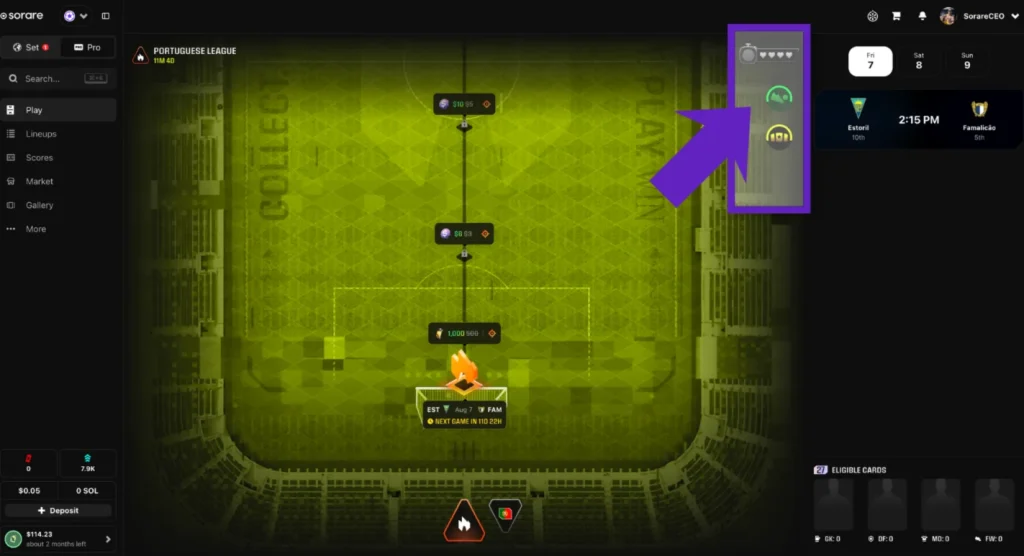
All of the above will be described in bigger detail further down this Sorare tutorial.
Finally, the right side of the screen is basically a calendar of games taking place today and in the subsequent days. At the bottom of that section, you can see all your eligible Sorare 27 cards for each game on the calendar.
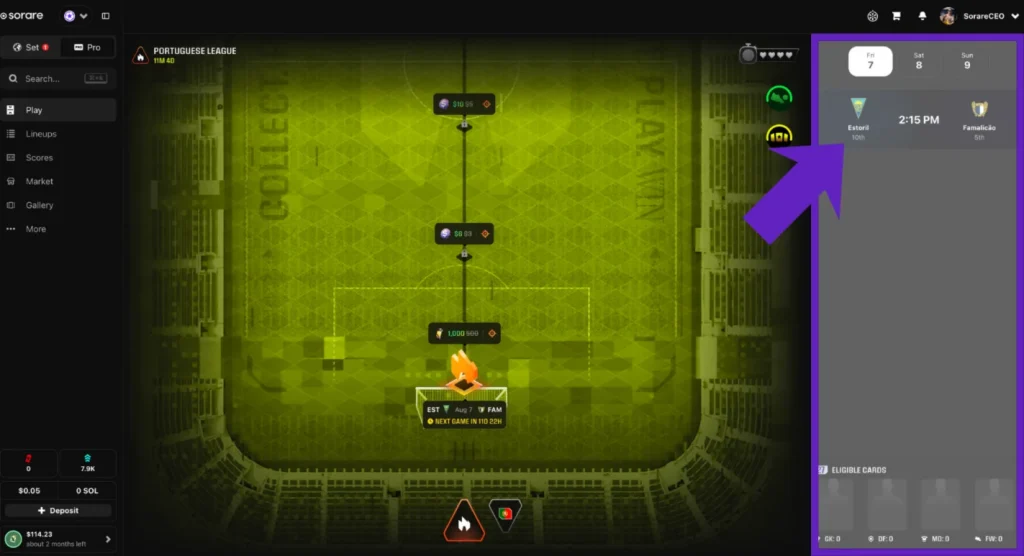
By now you should be more or less familiar with what awaits you in your first minutes on the platform.
But how to actually start playing? It’s time to dive into all the available game modes.
Beginner’s Guide to Sorare 27 Game Modes

Sorare 27 is the most advanced (and for some, the most complicated) version of the game so far and it distinguishes between three main playing modes:
- Arcade (previously known as Set) – the free-to-play mode
- Pro (previously known as Hot Streaks) – the paid mode in the form of Hot Streaks where you play against the game itself (meaning – against Sorare)
- Arena – the paid mode in the form of leaderboard where you play against other players
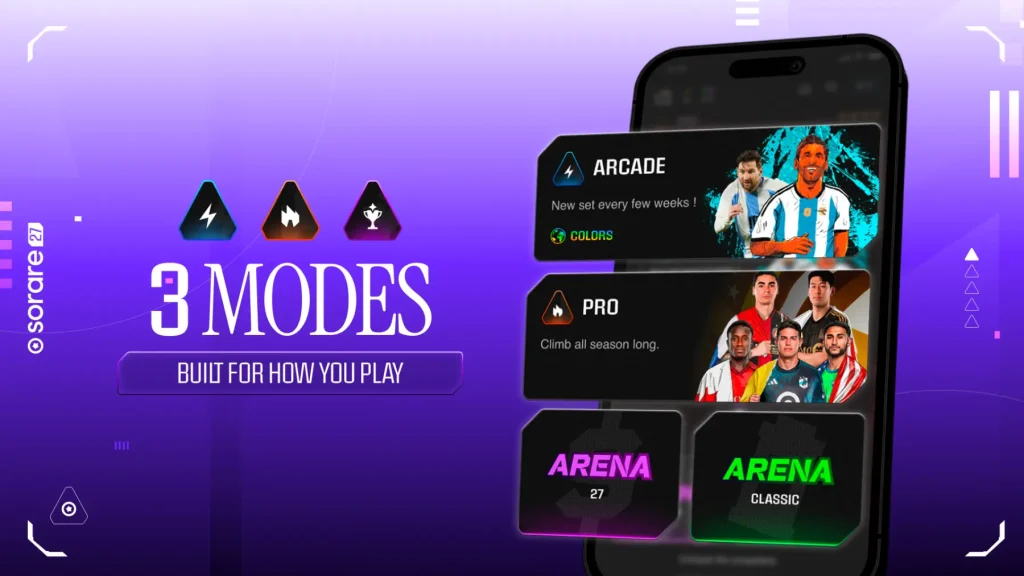
If you’re a complete newbie, starting your journey with the free-to-play mode would be a wise move. That’s especially true now that Sorare has introduced real cash rewards into Arcade. And while it’s only fair to say that they’re difficult to achieve without any prior investment, users who indeed manage to do so will then be allowed to reinvest the winnings into the “real” game, buying their first Pro cards.
Sorare Free-to-Play – Arcade
Whenever someone asks me how to play Sorare successfully and where to start, my answer is always the same: begin by learning the basics in the Free-to-Play mode.
Why, you might ask? Because this way you completely eliminate any costs associated with improving your “know-how”. After few weeks you will get better and then feel way more confident about investing funds!
Luckily for new managers like you, the Free-to-Play mode is available throughout the year. Sorare Arcade is by far the best onboarding game designed to this date. Not only because of the cash rewards it offers, but also because how engaging it is compared to the previous versions.
What I also like a lot about Arcade is that it perfectly mirrors the Pro version of Hot Streaks. Which means that once you understand the concept of Arcade, you can transition to the more rewarding (but also challenging) version of the game.
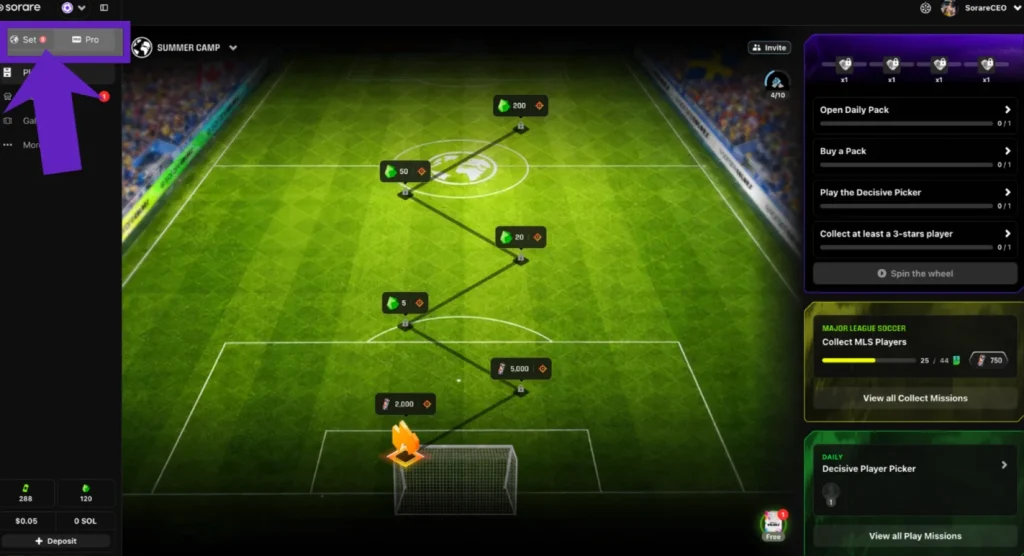
To navigate to Arcade (Set) game mode, make sure you click on the “Set” button to switch away from “Pro” – as marked in the screenshot above.
Duration
The Arcade mode consists of individual Sets. In other words, Sets are separate editions of the Arcade mode that usually last for 7-8 weeks each.
This is in great contrast to the Pro mode that lasts for as long as the football season runs in real life. During a period of a given Set, you collect cards for that Set specifically only.
Set cards which you use in the Arcade mode, unlike the Pro cards designed for the Pro modes, disappear after the Set is over and you start all over with new ones designed for the next Set.
In short: your card gallery lifespan in Arcade is ≈ 2 months whereas in Pro it’s lifetime.
Card aquisition
Unlike the Pro mode which gives you the chance to scout and buy the exact players you need, there’s element of luck involved in terms of card acquisition in Arcade.
Here you obtain new cards by buying card packs, something old-school card collectors (like me) are likely to enjoy. Card packs contain between 3-5 players of ranging quality, so their cost also differs.
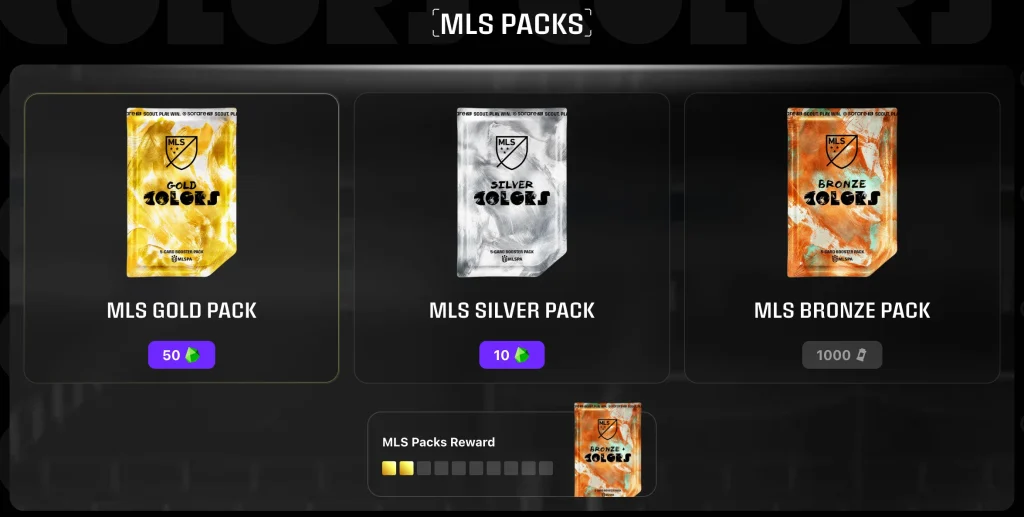
As you can see in the example above, Major League Soccer packs can be purchased for Essence (the in-game currency which I will explain in bigger detail later in this Sorare guide), 10 or 50 Gems. The bigger the price, the better the odds of getting top quality players.
Gems are the premium in-game currency in Sorare’s free-to-play mode and you can get them either by progressing on the Game Board, completing different Missions, or buying Gem bundles with your cash. With the latter, you’re essentially turning a free-to-play mode into a “Freemium”. Something I personally don’t like to do 🙂
Competition format
Everything in Arcade revolves around the Game Board which – depending on the individual Set – consists of between 5 and 6 steps.
As you’d expect, every step raises the bar a little higher in terms of the points required to complete it. Fortunately, the rewards improve just as quickly, making each milestone feel worthwhile.
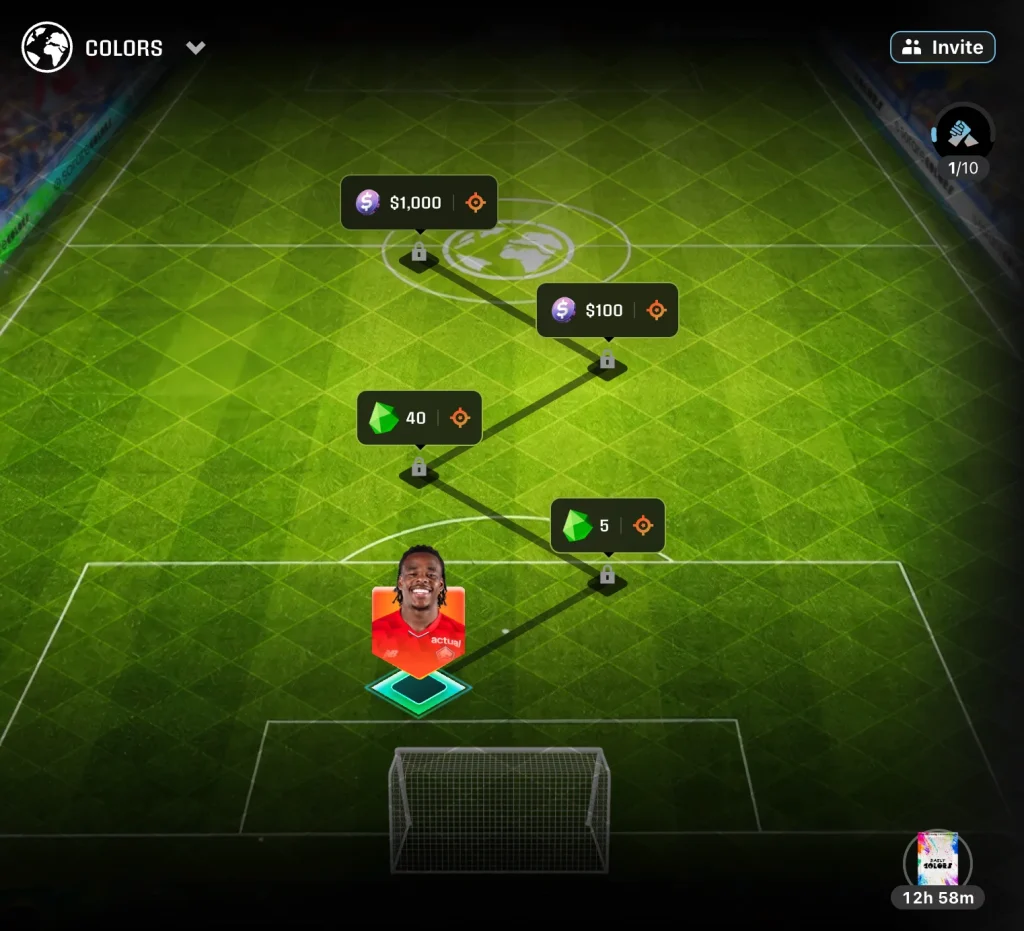
Above you can see an example of the Game Board (and the rewards) during the Colors Set that was dedicated to the World Cup 2026. The rewards were super generous during that Set but they were rather an exception than the norm.
Moreover, it has to be said that reaching cash rewards without any prior investment (= Gems purchase) was nearly impossible.
For example, to complete Step #1 your lineup needed to hit a team total of 260 points but if you were dreaming about success at Step #5, that number increased to 480 points. A 220 point difference, but also – what a change in terms of the prize!
One thing that immediately stands out is that Sorare Arcade is a PvE (Player versus Environment) experience. As already explained earlier in my Sorare tutorial, this means that instead of battling other managers directly, you are trying to beat score targets set by the game itself.
That is very different from traditional Pro competitions, where every reward depended on outperforming tens, hundreds or even thousands of other users.
To begin a run in the Arcade, you build a lineup consisting of five players. You need:
- one goalkeeper
- one defender
- one midfielder
- one forward
- one additional outfield player of your choice
See the screenshot below:
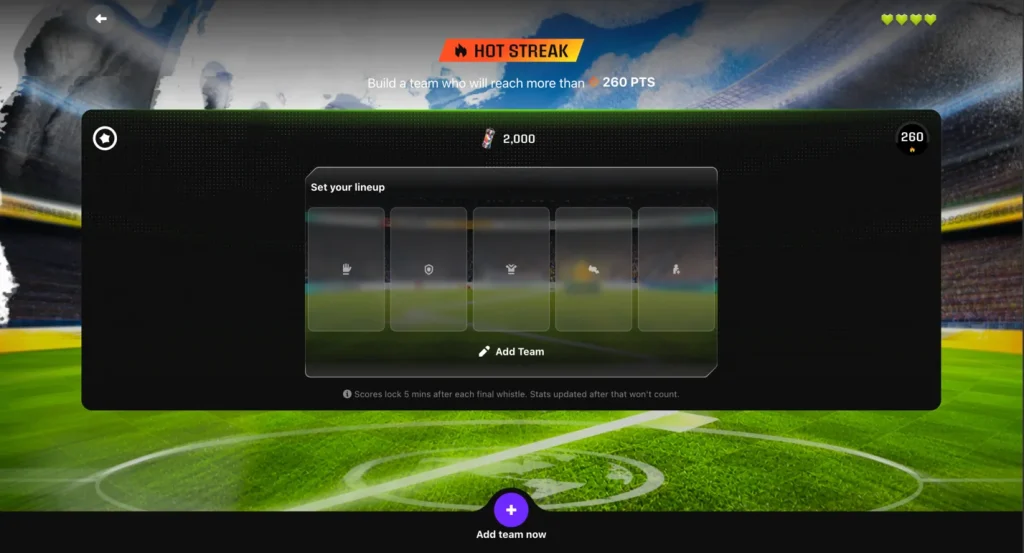
Once your lineup is locked, everything works exactly as you would expect. Your footballers play their real matches, earn points, and their points are combined into a final total.
Reach the required score, and you immediately advance to the next stage. As soon as your players’ scores become official (usually within about five minutes of the final relevant match ending), the next step on the Game Board unlocks automatically.
That alone makes the experience feel much quicker than the traditional Game Week format where you need to wait for specific dates (Tuesday and Friday) to see how you’ve done and only then collect your rewards (if there are any 🙂 )
There is another mechanic that makes progression far more exciting and doable. Each run gives you a limited number of lives. You begin with four, and every unsuccessful attempt costs one which gives us a bit of a breathing space.
💡 To sum up: it’s a good idea to give Arcade a try if you want to start with minimum or no investment, you enjoy the process of opening card packs, and you want to collect as many cards as possible as fast as possible. At the same time, make sure you’re willing to settle for less attractive rewards and the fact that all your cards will lose their utility after the given Set is over (so – after maximum of 2 months).
The Sorare guide you’re reading covers only the basics of Arcade. You can learn in bigger detail about this game mode, reading my in-depth introduction to Sorare Sets.
Sorare Pro (Hot Streaks 🔥)
In short, this is the Arcade mode but on steroids.
This is where the real fun (but also investment) starts.
This mode is designed for users who already understand the concept of the game presented in Arcade and feel confident enough buying their first Pro cards.
Join Sorare with code SORARECEO to get free $150 for your first cards.
SORARECEO
COPY
SorareCEO.com is a certified affiliate partner of Sorare. This is an exclusive bonus for my readers.
In contrast to Arena (the other version of the Pro game which we will discuss further down in this Sorare tutorial) where you compete against other players, by playing Hot Streaks you’re competing against the game itself.
This means that in order to win (or at least make a good progress), you have to reach the points target set for you by Sorare – just like in the Arcade mode.
The fact that free and paid game modes mirror each other so well is definitely a smart move as it makes the transition from free-to-play to Pro a lot smoother.
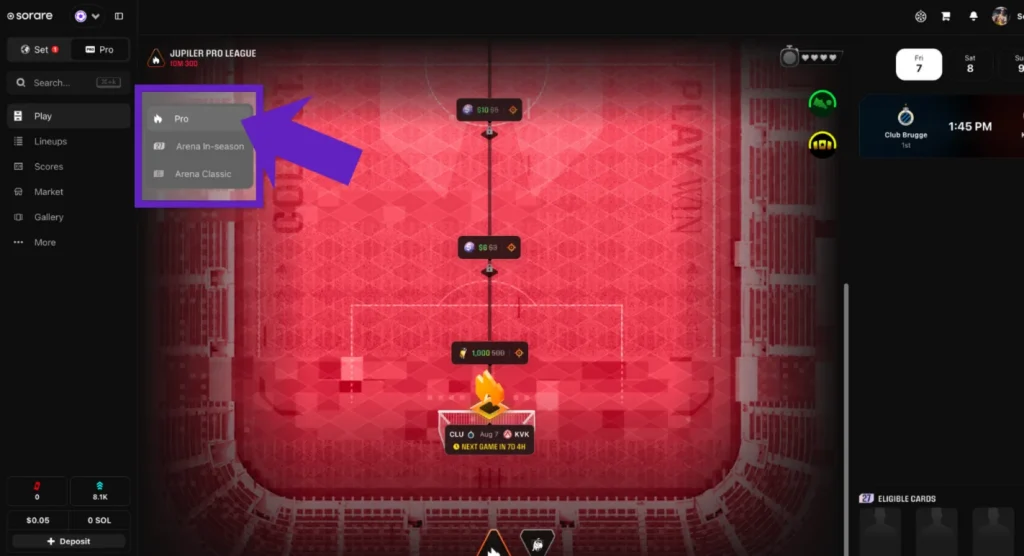
You will find Hot Streaks Pro under the Pro tab (see the screenshow above).
Just like in Arcade, every completed step unlocks the next one, where the required score becomes slightly higher. As you continue progressing, the rewards become increasingly valuable, eventually leading to real cash prizes that can be withdrawn directly to your bank account. If you prefer, Sorare also lets you withdraw your winnings in supported cryptocurrencies.
The system is very beginner-friendly because success depends on hitting clearly defined score thresholds rather than beating thousands of opponents.
Example of possible rewards in Hot Streaks Pro can be seen below for the English League:
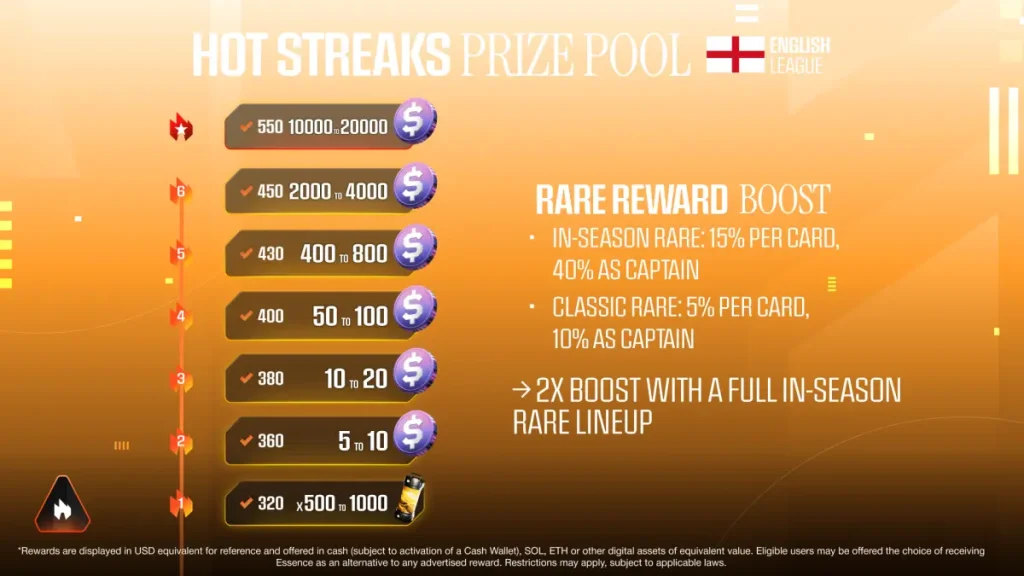
Similarly to the Arcade, each Hot Streak step in Pro gives you four lives.
If your lineup reaches the required score, you immediately move on to the next stage and receive four fresh lives. If you miss the target, you simply lose one life and remain on the same step until you either complete it or run out of attempts.
Moving Locks & Anytime Entry
One of my favourite additions in Sorare 27 is the introduction of the so-called moving locks.
In previous season’s Hot Streaks, every lineup had to be submitted before the entire Game Week started. If you missed the deadline or wanted to react to confirmed starting lineups later in the weekend, you were simply out of luck.
That’s no longer the case.
Hot Streaks in Sorare 27 now use a moving lock system. Instead of one global deadline, every lineup locks only when the first player in that specific lineup kicks off their match.
This means you don’t have to prepare every lineup on Friday afternoon.
You can enter Hot Streaks whenever you want, provided there are still eligible fixtures left to play. You might submit one lineup on Friday, another on Saturday morning after the official starting elevens are announced, and another on Sunday before the afternoon fixtures.
Because of this flexibility, you’re no longer forced to guess whether a player will start. In many cases, you can simply wait until the team sheets are released and only use players who are confirmed in the starting XI.
However, in my eyes, the biggest advantage of moving locks is the speed of the game.
If you complete a Hot Streak step early in the matchday, you don’t have to wait until next weekend to continue your run. You can immediately build another lineup using players whose matches haven’t started yet and attempt the next step.
In practice, it’s entirely possible to clear multiple Hot Streak levels during the same weekend if your lineups keep reaching the required score targets. Combined with anytime entry, this makes Hot Streaks feel much more dynamic than in previous the previous season, where we had to wait an entire Game Week before progressing further.
One use per card
Moving locks don’t mean you can use the same card over and over again.
Once a player card has been used for a specific match, it becomes locked for that fixture and can’t be entered into another Hot Streak lineup involving the same game.
However, the lock is tied to the fixture, not the entire weekend.
For example, if you use Ousmane Dembélé in PSG’s Saturday match, you can’t reuse him for that fixture in another lineup. But if PSG plays again a few days later, you can immediately use the same card again for the new match.
Playing Hot Steaks Pro, your lineups will consist of 5 players:
- Goalkeeper
- Defender
- Midfielder
- Forward
- Extra outfield player
4 out of 5 cards in your lineup will have to be In-Season cards, meaning that they will have to be the editions released for the 2026/2027 football season. You’re allowed 1 Classic (out-of-season) card per lineup.
During Sorare 27, Hot Streaks are available exclusively in the Limited and Rare card scarcities (more about card scarcities later in this Sorare guide).
The Hot Streaks competitions are as follows:
- English League (in other words: the Premier League)
- French Ligue 1
- Spanish LA LIGA EA Sports
- German Bundesliga
- Liga Portugal
- Eredivisie
- Jupiler Pro League
- Scottish Premiership
- English Second Division (in other words: the Championship)
- Contender (a group competition containing Austrian Bundesliga, Croatian HNL, German 2. Bundesliga, French Ligue 2)
💡 To sum up: Pro Hot Streaks mode is recommended for players who have a lot of free time during the weekend and are willing to participate in the game for (possibly) many hours a day. They are great for managers who want to make sure that their players actually play! With that said, prepare to spend in order to be really competitive and have a realsitic chance of winning the biggest prizes.
Sorare Arena
The Arena is how the whole game looked years ago when there was no Hot Streaks. It’s just you against other players competing on a (big) leaderboard – and it’s the game I’m going to play in Sorare 27.
Unlike Pro Hot Streaks in which you’re allowed to use just one Classic card per lineup, Pro Arena includes competitions that allow you to set lineups made up of exclusively “Classics” (and as a holder of hundreds of Classic cards, this is really appealing to me).
The Pro Arena is divided into three modes:
- In-Season Arena – leaderboards focused on In-Season cards
- Classic Arena – leaderboards focused on Classic cards
- Arena Rooms – exclusive 10-player rooms
| In-Season | Classic | Arena Rooms | |
|---|---|---|---|
| Lineup Size | 5 cards | 7 cards | 5 cards |
| Cash Prizes | ✅ | ❌ | ❌ |
| Card Eligibility | Mainly In-Season cards | All seasons | All seasons |
| Reward Types | Cash, Essence | Cards, Essence | Essence |
| Best Use Case | Cash-focused users with more to spend | Users with big galleries or smaller budgets | Users with smaller collections |
Now it’s the perfect time for my Sorare beginner’s guide to explain each mode in bigger detail.
In-Season Arena
We could call it the “core” Arena mode. It offers by far the most exciting rewards, but it also forces us to use In-Season cards. This essentially means a new investment every time a new football season starts.
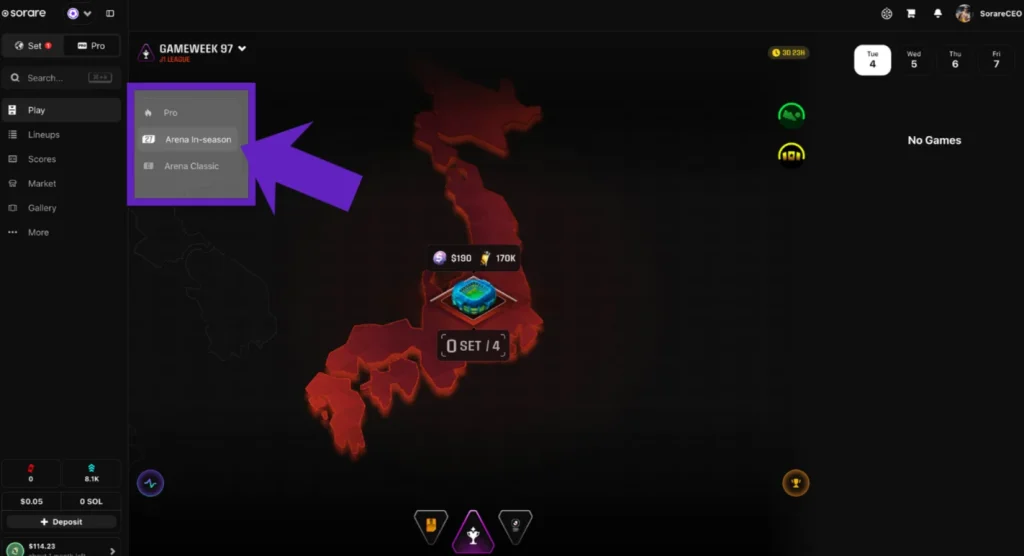
I’ve marked how to navigate to the In-Season Arena competitions in the screenshot above. It’s in the Play -> Arena In-Season tab.
To participate in the In-Season Arena competitions, you create 5-player lineups that require at least 4 player cards from the current season. Just like in the Pro Hot Streaks mode discussed above, you’re allowed 1 Classic (out-of-season) card per lineup.
See the screenshot below:

The In-Season Arena is the only Arena mode in which you can win cash so it actually makes sense that Sorare wants us to first spend something in order to have that opportunity.
As an example, to compete in the In-Season Premier League competition for the 26/27 season, you’d need 4 Arsenal players from the 26/27 card collection and 1 Manchester City player from any of the previous seasons.
Your Arena In-Season lineup will consists of:
- 1 Goalkeeper
- 1 Defender
- 1 Midfielder
- 1 Forward
- 1 Additional outfielder (any non-GK position)
Participating in the Arena In-Season competitions, you can win:
- Cash rewards
- Essence
The above rewards can be won in In-Season Arena’s dedicated competitions. They differ slightly based on the card scarcity.
You can check out the juicy-looking weekly prize pools for In-Season Arena for the English league.
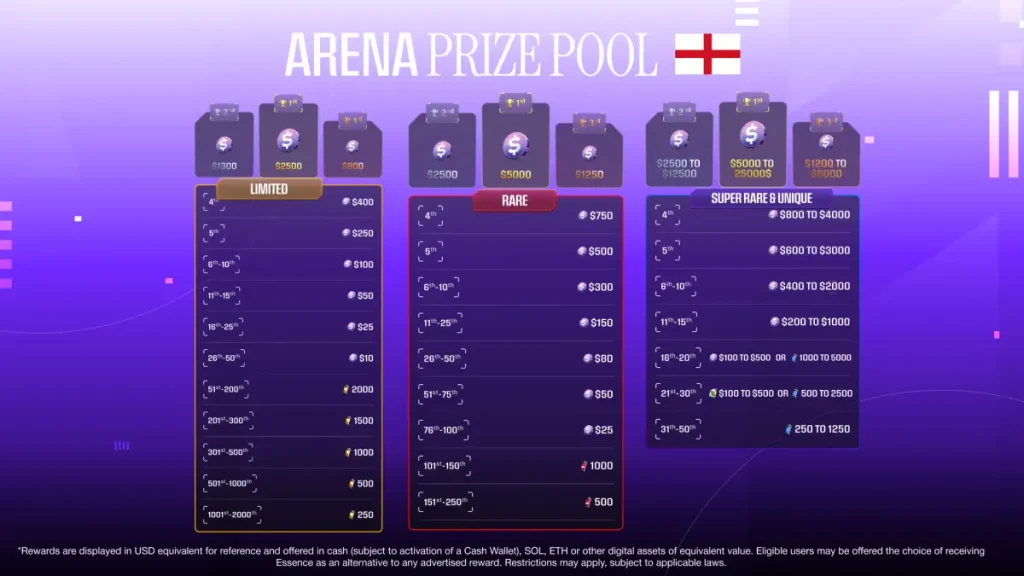
For Limited and Rare scarcities, the dedicated competitions are as follows:
- English League (in other words: the Premier League)
- French Ligue 1
- Spanish LA LIGA EA Sports
- German Bundesliga
- Liga Portugal
- Eredivisie
- Jupiler Pro League
- Scottish Premiership
- English Second Division (in other words: the Championship)
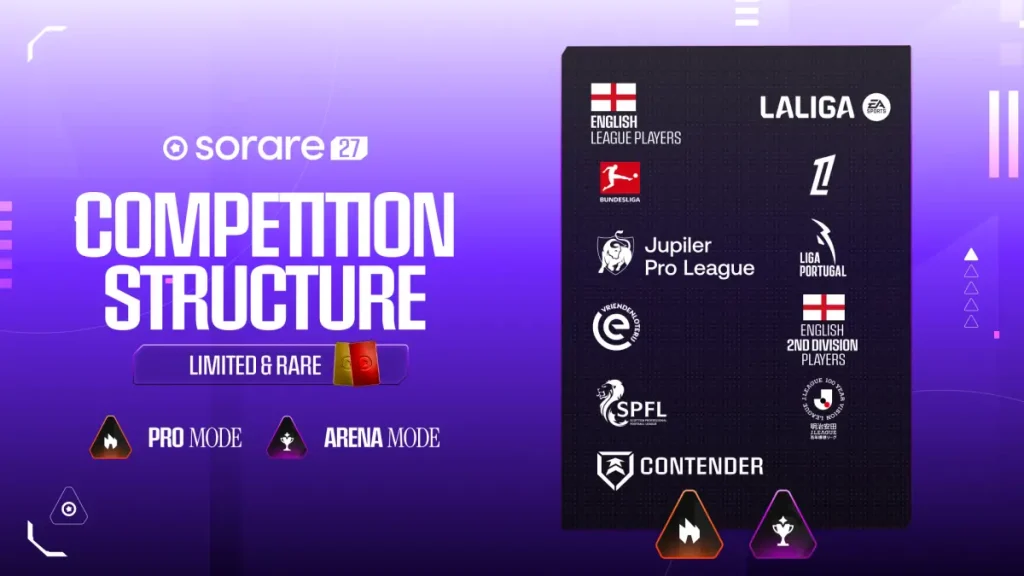
For the two other, more exclusive card scarcities – Super Rare and Unique – the dedicated competitions look like this:
- English League
- Ligue 1
- LALIGA EA SPORTS
- Bundesliga
- Liga Portugal
- Eredivisie
- Jupiler Pro League

Apart from dedicated comps, there are also regional tournaments.
For Limited & Rare competitions in Sorare 27, it looks like this:
- Contender – covering Austrian Bundesliga, Croatian HNL, German 2. Bundesliga, French Ligue 2
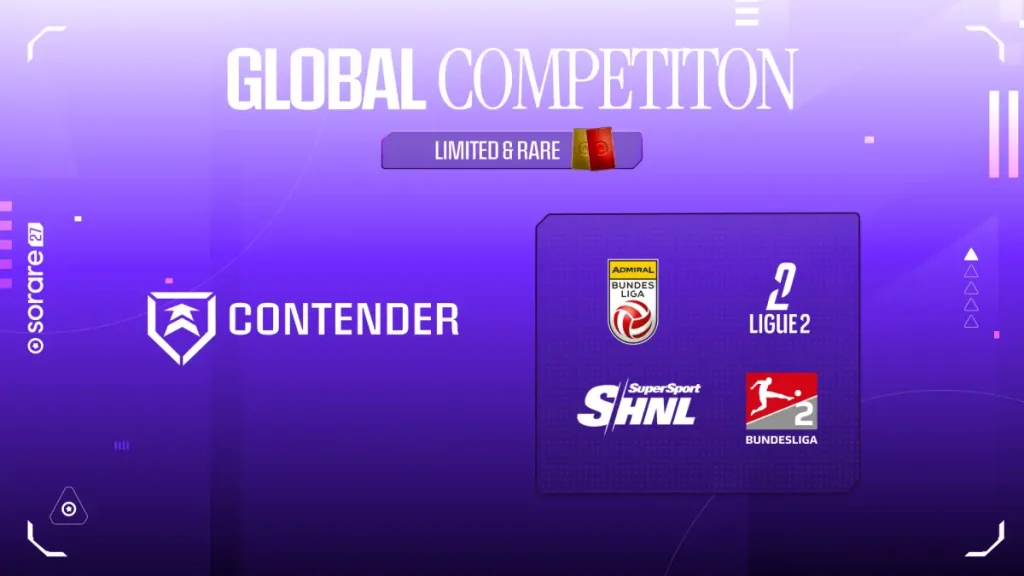
And for the Super Rare and Unique, like below:
- Rest of the World – Scottish Premiership, English second division (Championship), J.League, Austrian Bundesliga, Croatian HNL, 2. Bundesliga, Ligue 2

💡 To sum up: if you have a bigger budget, love competing against other people instead of against the game, and prefer to win cash instead of new cards, the In-Season Arena is the game mode you should choose.
Arena Classic
Classic Arenas are a great solution for those who love the game but are not willing to re-invest new money into it every time a new football season starts.
As already explained earlier in my Sorare guide, In-Season competitions such as Hot Streaks or Arena In-Season require as many as 4 current-season cards.
Classic Arenas don’t!
And to this day my favorite thing about Sorare is that the Pro cards I buy can be used for as long as the player’s career continues – and that’s why I love the Classic mode.
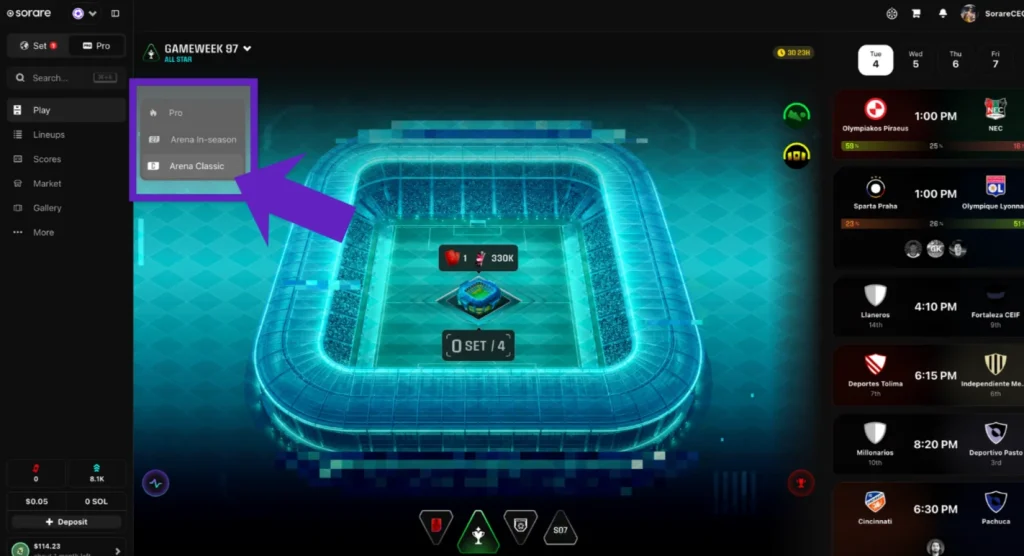
To navigate to the Arena Classic view, hover over the “Play” tab and click “Arena Classic” – just like in the screenshot above.
In terms of Classic Arenas, you will have to field 7 instead of 5 cards. See the screenshot below:

Classic lineup structure includes:
- 1 Goalkeeper
- 2 Defenders
- 2 Midfielders
- 1 Forward
- 1 Extra outfield player (any position)
The reason for this is simple: the number of Classic cards increases season after season, so Sorare has to decrease the overall number of lineups to reward a bigger percentage of managers. That’s exactly what 2 extra cards in a lineup help to do!
This mode rewards:
- New In-Season cards
- Essence (in-game currency)
- Occasionally market credits
Below you can see the weekly prize pool for the All Star Classic Arena.
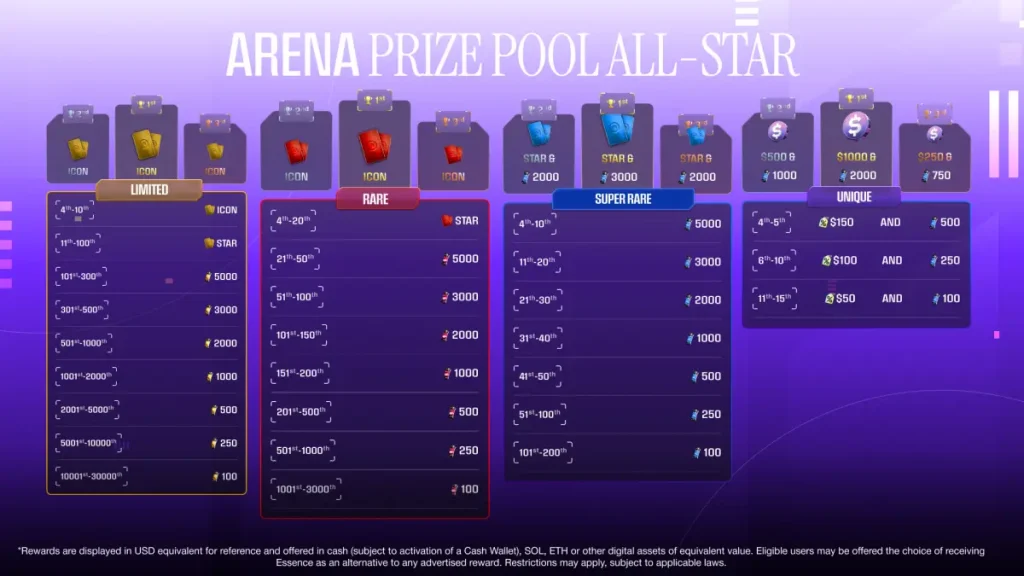
Unlike the In-Season game that offers a long list of competitions, the Classic mode is limited to three core tournaments:
- All-Star – Any player from any team globally
- Champion Europe – cards from top 5 leagues only (Premier League, La Liga, Bundesliga, Serie A, Ligue 1)
- U23 – Only players who were 23 or younger as of July 1st of the current season. It’s my favorite, because it’s packed with wonderkids and a perfect playground for scouts who follow youth development closely 🙂
💡 To sum up: if you have a big gallery of Classic cards (or plan to buy a lot of them) and you prefer to win in-game items and new cards instead of cash, this is the mode for you. However, be prepared that it’s the most competitive mode on the whole platform due to the sheer number of minted Classic cards.
🏟️ Arena Rooms
Unlike the other Classic competitions discussed above in which you are up against thousands of other lineups, Arena Rooms offer a way more compact and exclusive competition.
It’s just you vs 9 other managers.
Moreover, it’s the only Classic mode in which 5 cards are enough, so in this sense it actually mirrors the In-Season competitions.
You submit one lineup, pay a small Essence fee, and battle it out. If your squad outscores the others, you win rewards. Simple as that.
Here’s how it goes:
- Pick an Arena competition — different ones run based on card scarcity (Limited, Rare, etc.), points cap, and region
- Submit a team of 5 cards: GK, DEF, MID, FWD, and one Extra (just like In-Season Arena)
- Pay the small entry fee in Essence (100, 200, 300 or 800 Essence – depending on the competition)
- You’re matched with 9 other managers in your bracket
- If you finish in the top 1–5, you earn rewards
You can join multiple Arenas per week… it’s a repeatable grind loop. For newer or casual players, it’s one of the most accessible ways to earn in-game items.
Arena doesn’t offer cash payouts or new card rewards like leaderboard competitions. Instead, it’s focused on Essence and XP bonuses that you can apply to your cards.
- 1st place: highest Essence payout
- 2nd–3rd place: smaller Essence rewards
- 4-5th – XP bonuses
- Everyone else: No reward, but no penalty beyond entry fee
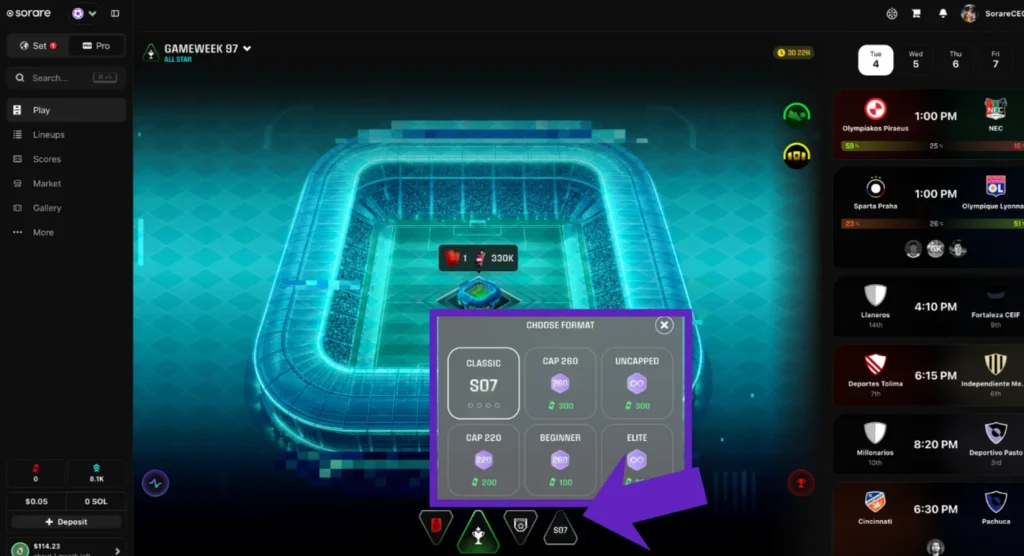
Once in the Arena Classic tab, look for the “SO7” icon at the bottom of the screen (as seen on the screenshot above). After clicking on it, you’ll be able to select any of the 5 Arena Room competitions:
- Cap 260 – where the total average score of your team needs to be 260 points or less
- Cap 220 – same as above, but limited to 220 points
- Uncapped – no score limits
- Beginner – 260 points cap with a smaller stake
- Elite – 260 points cap with a bigger stake
Arena might not get as much hype as the big-paying tournaments, but it’s quietly one of the most efficient ways to grow your card gallery.
💡 To sum up: opt for Arena Rooms if the prospect of going against thousands of other managers with big Classic galleries sounds too challenging.
Which Pro game mode to choose?
In my opinion, to be competitive in Pro in Sorare 27 you have to decide whether you’ll focus on Hot Streaks or Arena. My choice for this year is the latter.
For me, the main reason why I’m picking the Arena over the Pro Hot Streaks is the time required to successfully compete in each mode.
The fact that in Hot Streaks there are no fixed Game Week deadlines and there are hundreds of games each weekend across all competitions, to give yourself a good chance of being successful you’ll have to be constantly logged-in, always looking for best opportunities to progress on the Hot Streaks game board. And although I’d love to be able to do that, my life commitments simply won’t allow it this year.
Join Sorare with code SORARECEO to get free $150 for your first cards.
SORARECEO
COPY
SorareCEO.com is a certified affiliate partner of Sorare. This is an exclusive bonus for my readers.
Another reason why I’ll be opting for the Arena instead is the number of cards needed to be really competitive.
As someone who has spent the last 4 months actively playing the free-to-play Arcade mode, I know that even having close to 1,000 cards doesn’t guarantee achieving the highest steps on the Game Board. If I wanted to have a similar number of cards in the Pro Hot Streaks, that would require a massive investment and also a financial risk that comes with it. And again, it’s one that I’d love to be able to make but I simply can’t this year.
💡 My overall advice: Since the goal of this Sorare tutorial is to help you make wiser decisions with less effort, I suggest that if you love the concept of Sorare Arcade, you’re going to love Pro Hot Streaks more than the Arena. But please – only decide to focus on it if you have A LOT of free time on the weekends, a fairly large budget, and the willingness to take more financial risks. Otherwise, I suggest you take the same path as me for Sorare 27 and try your luck in one of the Arena In-Season competitions. Alternatively, focus on Arena Classic if you have a decent Classic gallery. This way you can try to win some Essence in Classic competitions, craft In-Season cards, and only then enter the Arena In-Season competitions without any extra investment.
Sorare Scoring Matrix Guide

As I’ve already mentioned, the scoring of Sorare cards you collect and use in prize-filled tournaments is based on the real-life performances of footballers during specific matches. This is known under the fancy name of Sorare Scoring Matrix.
The game’s scoring system is designed to accurately reflect a player’s in-game contribution and is regularly updated to make sure it stays as close to reality as possible.
I would be lying if I said that it’s super straightforward and easy to grasp right away – it’s not.
But that’s what makes it even more exciting. And the better you understand the mechanism of the Matrix, the more equipped you will be to find the right players for your system, and the bigger the chance you will have of succeeding in the weekly tournaments.
I’ve already written an ultra-detailed guide to Sorare Scoring Matrix but the information you find below should give you a decent grasp of how it works. Enough to get you started anyway.

So, how is the Sorare score calculated?
A player can score between 0 and 100 points, with 0 being the absolute horror show of performance and 100 a true match-winning display. A player will also get 0 points if his contribution to the game has been marked as DNP (Did Not Play).
The 0-100 point scale is made up of two components:
- Decisive Score
- All-Around Score
The final score of the player is Decisive Score (DS) + All-Around Score (AAS) [or + zero if AAS is below 0 (negative)].
Let’s now look into how both of them work for you (or against you!).
Decisive Score
As the name suggests, this score is based on important, decisive contributions to the game. All players start at Level 0 Decisive Score.
| DECISIVE SCORE | |
|---|---|
| POSITIVE | NEGATIVE |
| Goal | Red card |
| Assist | Own goal |
| Penalty won | Penalty conceded |
| Clearance off the line | Error leading to goal |
| Clean sheet (only keepers) | |
| Penalty saved (only keepers) | |
| Last man tackle | |
Level 0 equals 35 points for a player that plays in the game (either a starter or as a substitute later in the game).
From the moment the player starts taking part in the game, his Decisive Score can either be improved with decisive, positive contributions or decreased with decisive, negative contributions. Each positive impact levels up the score and each negative impact levels it down.
The maximum positive Level a player can reach is 5 while the maximum negative Level is -3.
- Level -3 = 0 points
- Level -2 = 5 points
- Level -1 = 15 points
- Level 0 = 35 points
- Level 1 = 60 points
- Level 2 = 70 points
- Level 3 = 80 points
- Level 4 = 90 points
- Level 5 = 100 points
What’s crucial in this scoring system, if a player finishes the game on Level 1 (for example, he had 0 negative contributions and assisted a goal), he will have a minimum player score of 60 regardless of whether his All-Around Score metrics are negative.
If his All-Around Score is bigger than 0, it will just add to his overall Player Score but if he manages -5 in the All-Around Score, his final Player Score can’t drop below 60.
Naturally, the same rule applies to all the other levels above 0.
All-Around Score
While the Decisive Score is easier to track and is based on just 11 decisive contributions to the game, the All-Around Score consists of, well, everything else.
It includes 40 different match events (passes, tackles, blocks, etc.) that are being monitored by Opta (the leading provider of live sports data) and Sorare’s team of analysts.
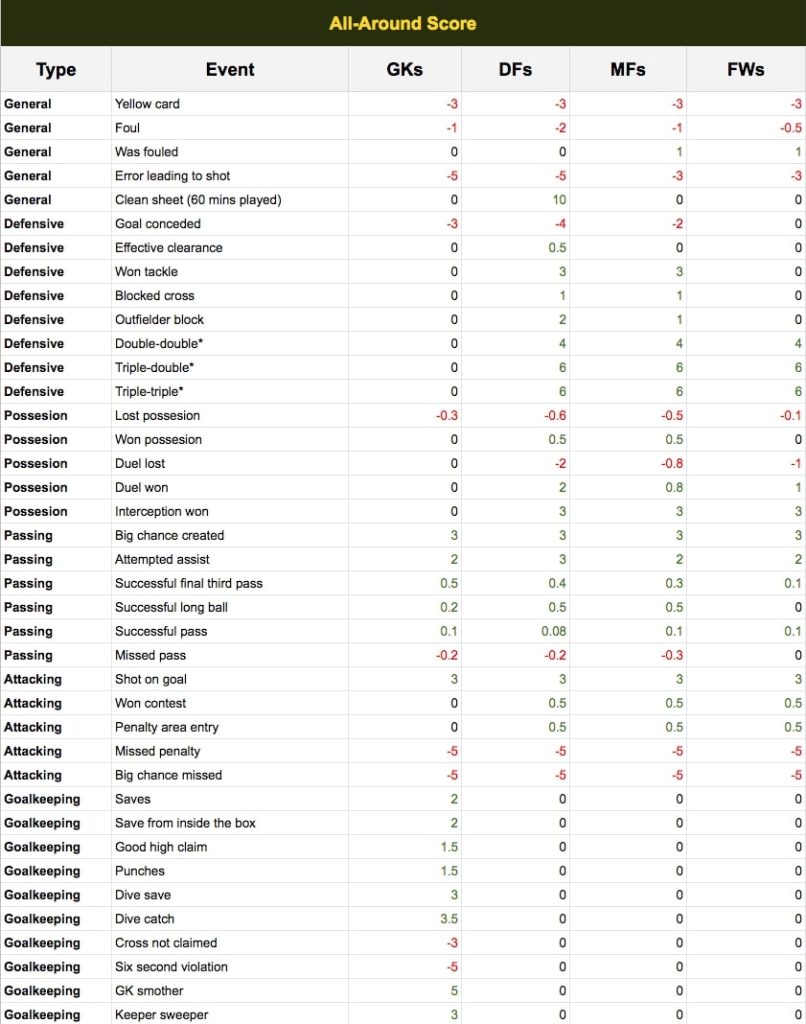
The level of importance of each event is different and each event has also a different weighting according to the player’s position. For example, a won tackle for a defender or midfielder will get him extra 3 points but since it’s not the job of a forward, the reward is 0.
How to Find the Right Players?

Finding great players is probably the biggest skill you can develop on Sorare.
Anyone can buy the biggest names in football, but that’s rarely enough to build consistently successful lineups. The managers who perform well over a long period are usually those who understand why certain players score well in the Scoring Matrix you learned about earlier in my Sorare guide.
Yes – just because you’re watching a game of football and think the player is having a great game, doesn’t mean he’s scoring well in the Matrix. I’ve been there, I’ve done that! (probably way too many times considering my experience 🙂 )
Instead of looking only at goals and assists, you should also pay attention to the hundreds of small actions players perform during a match. Once you start thinking this way, you’ll discover that some of the best Sorare players aren’t necessarily the biggest football stars.
Start with the Scout Market
To scout for new players to add to your gallery, navigate to Market -> Scout, using the left-side navigation bar.
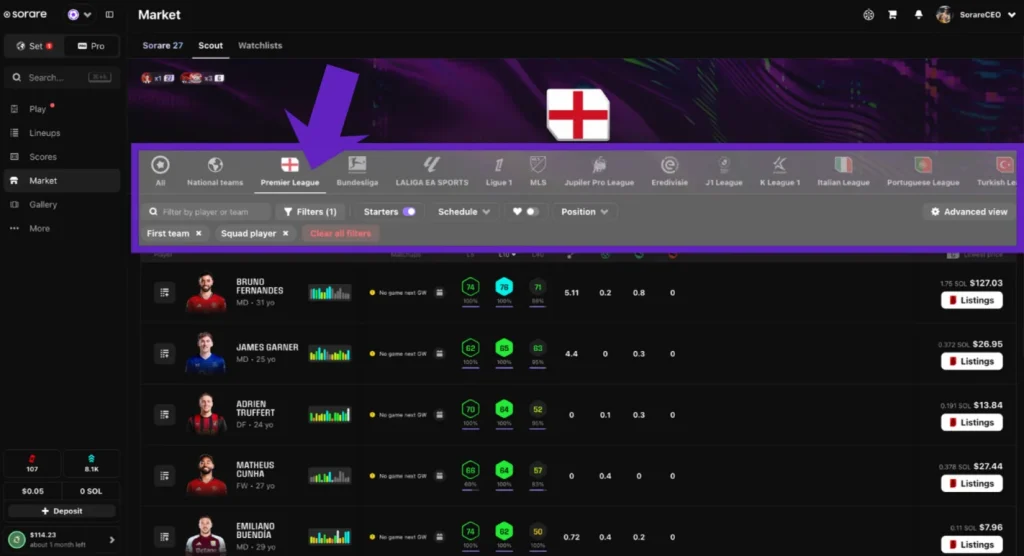
What you see in the screenshot above is the main scouting tab. I’ve highlighted the part that allows you to filter players by league, club, position, age and many other criteria. This becomes especially useful when you’re trying to build stacks from a particular club or you’re searching for players within a specific budget.
I also recommend enabling the Starters filter whenever possible. There’s no point analysing players who rarely make the starting lineup if you plan to have success with your teams in the near future.
At first glance you’ll already see plenty of useful information, including the player’s recent averages over the last 5, 10 and 40 matches, their closest upcoming fixture and the current market price.
However, those numbers only tell part of the story. One feature that many beginners completely overlook is the Advanced View. You can find on the right of the scouting tab, as highlighted in the image below.
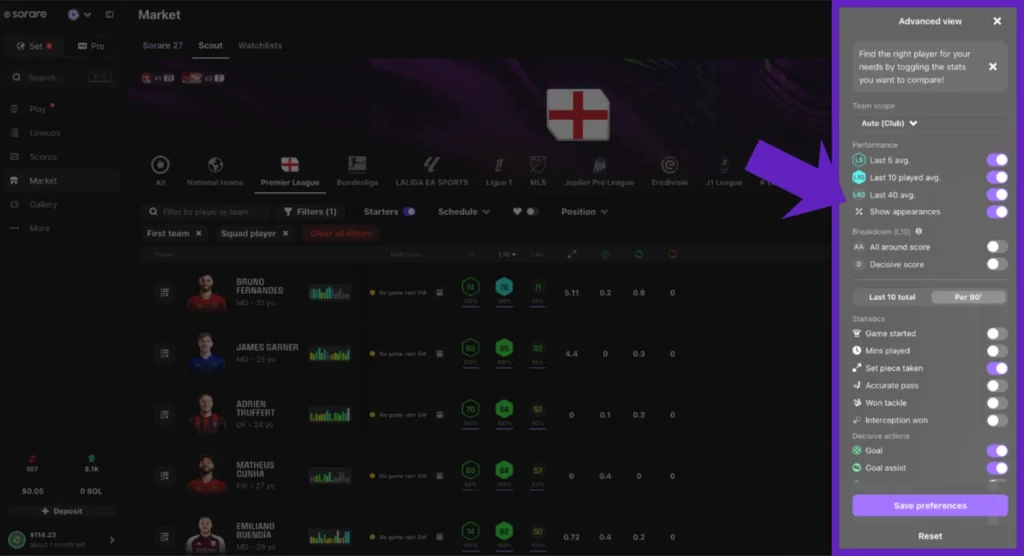
This allows you to customise exactly which statistics are displayed in the player list.
Instead of only looking at averages, you can compare dozens of individual metrics that directly influence Sorare scores.
For example, you can display:
- Accurate passes
- Won tackles
- Interceptions
- Set pieces taken
- Goals and assists
- Minutes played
- Many other Scoring Matrix statistics
This is incredibly useful when you’re looking for players who fit a specific profile.
For example, if I’m searching for a midfielder with a high All Around Score, I’ll often enable statistics such as accurate passes, tackles and interceptions. If I’m looking for an attacking player, I may focus more on decisive actions like goals and assists or big chances created.
Once you’ve saved your preferred filters, they’ll remain available every time you return to the Scout page.
Player’s performance page
One mistake I see beginners make all the time is buying players purely because they have a high L5 or L10 average.
Those averages are certainly useful, but they don’t explain how the player actually reaches those scores.
A striker averaging 65 because he scored four goals recently is a very different asset from a midfielder averaging 65 thanks to consistently strong All Around Scores.
The second player is often much more predictable over the long run. Whenever I’m considering a new purchase, I always open the player’s profile before making any decision.
Once you visit a player’s page, you can actually track down his performance even few years back! You can see with your own eyes how consistent he is and what is his ratio of decisive actions to solid All-Around scores.
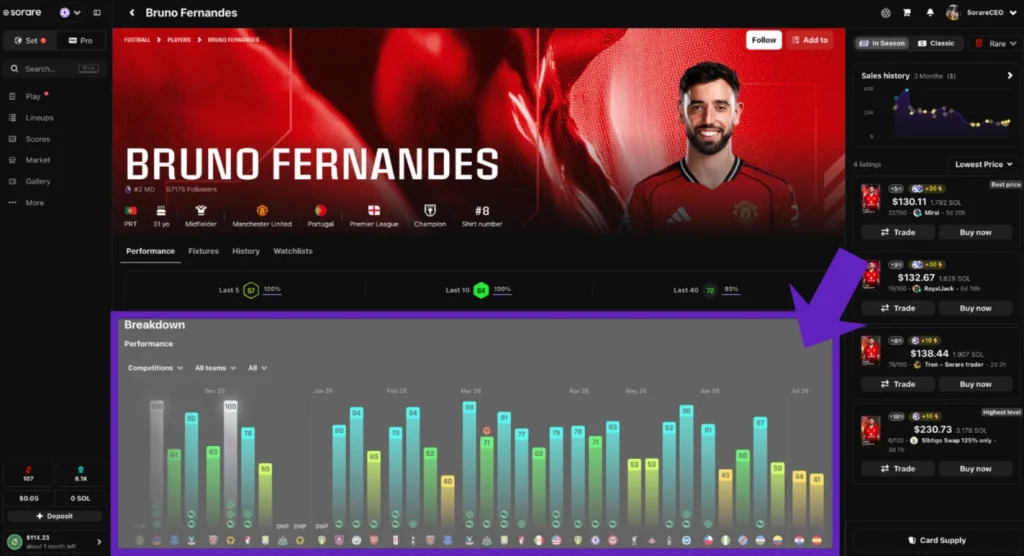
See the performance breakdown of Bruno Fernandes I’ve highlighted for you in the screenshot above. That’d be a great buy! 🙂
If one particular performance catches your attention, you can go even deeper.
The statistics panel below the chart shows exactly how that player accumulated their points during the selected period. You’ll see everything from passes and tackles to interceptions, set pieces, goals and assists.
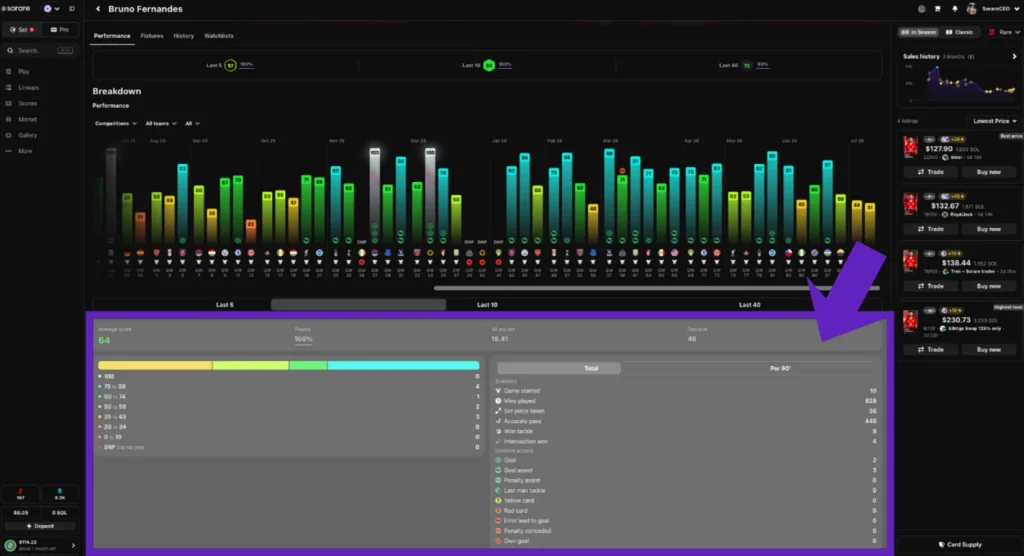
This is where understanding the Sorare Scoring Matrix really starts paying off.
Once you know which actions are heavily rewarded for each position, you can quickly identify players whose playing style naturally produces strong Sorare scores, even when they don’t appear on the scoresheet.
For example, a defender who constantly wins duels, makes interceptions and completes hundreds of passes may quietly average 60 points every week without ever scoring a goal. Those are often the kinds of players I’m happiest to own 🙂
Lineup Composition Tutorial & Tips

Up until Sorare 27, the process of lineup creation was something you could have gone through up to two times a week. Game Weeks ran during the weekend (Friday to Tuesday) and midweek (Tuesday to Friday) exclusively.
After the introduction of Hot Streaks Pro without fixed Game Week deadlines in this year’s edition, you can now submit literally tens of lineups PER DAY.
To begin creating lineups, you have to decide in which mode you want to submit them. Let’s assume you want to play Arena Classic like I do. In this case, please pick it from the “Play” tab.
Now look at the screenshot below. Once in the Arena Classic, you need to select for which Game Week you want to submit the lineups. As you can see, you can create lineups for days or even weeks ahead – and each GameWeek displays the logos of available competitions on the right.
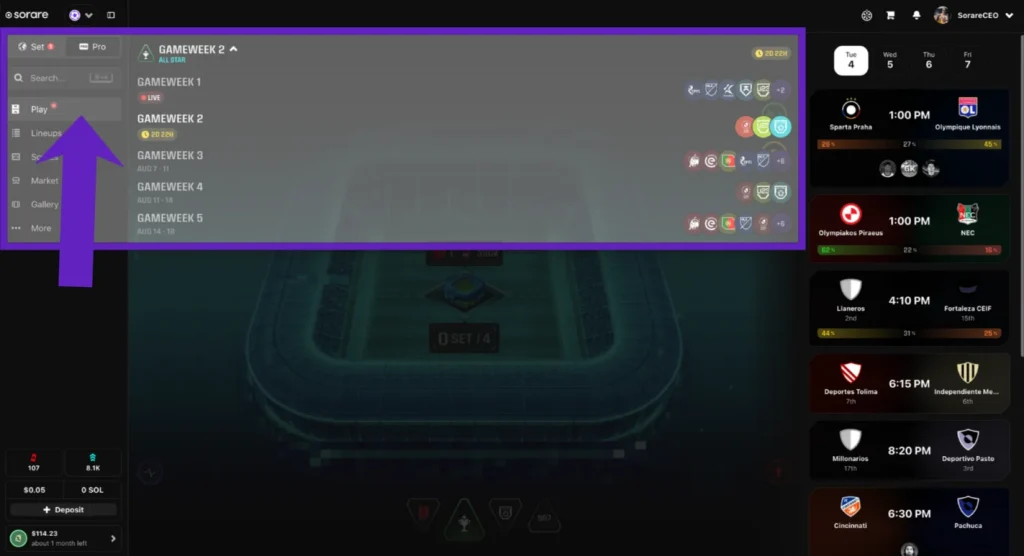
After selecting the Game Week, you should know pick the competition. Look at the screenshot below to see how Sorare shows you the available tournaments for that Game Week.
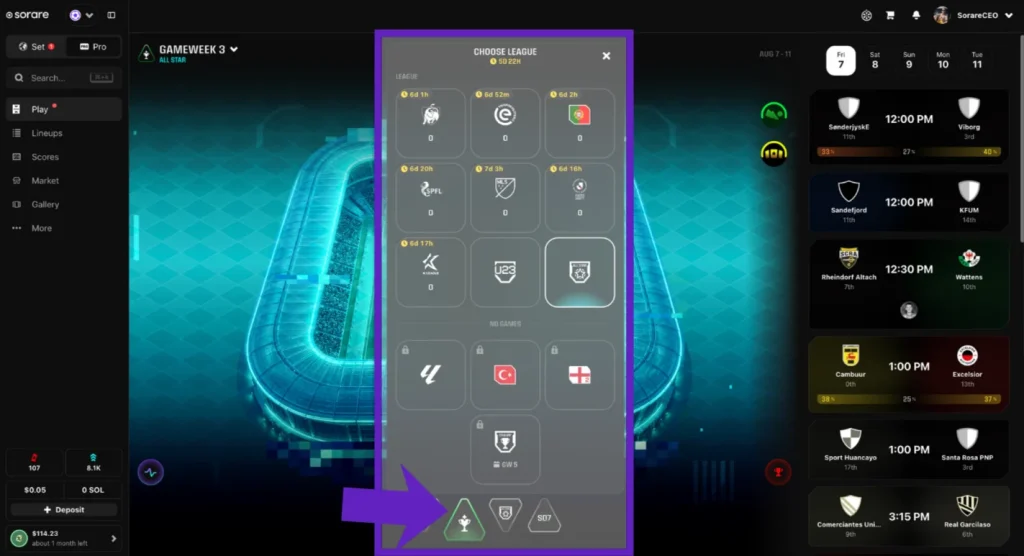
After selecting your competition, click on the stadium icon marked for you in the picture below.
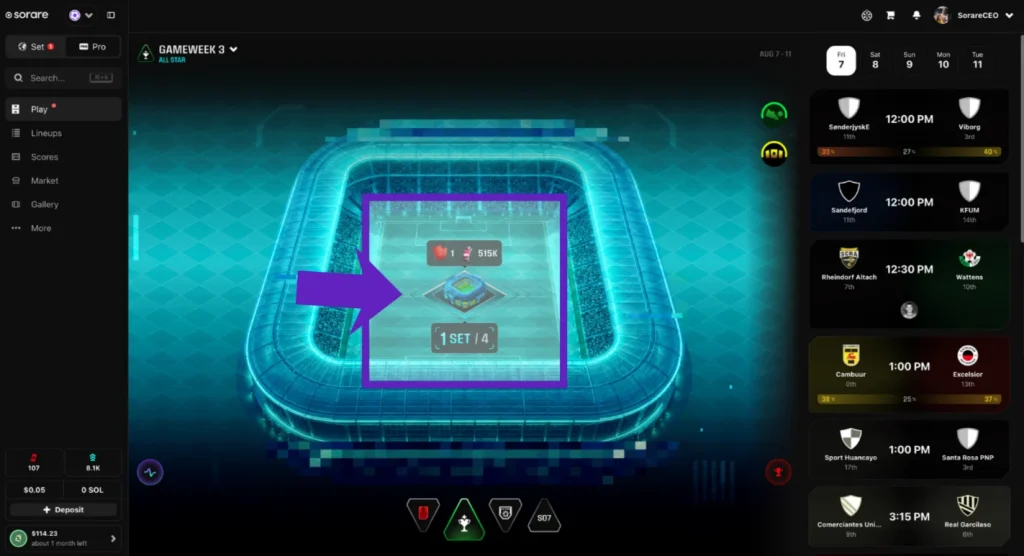
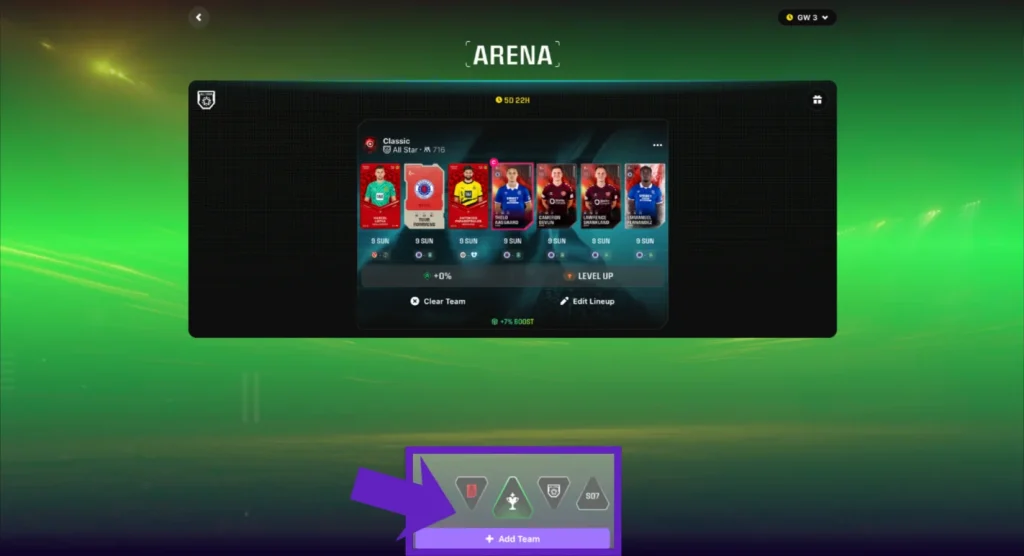
You can create up to 4 lineup per each competition in Sorare 27. To create more, click the “Add Team” button I highlighted for you below.
Every Sorare lineup (whether you’re playing Arcade, Hot Streaks or Arena) follows the same core rule: your team must include cards covering five specific roles.
Since you’ve gone so far in this Sorare guide already, by now you should already know that these are:
- 🧤 Goalkeeper
- 🛡️ Defender
- 🎯 Midfielder
- ⚽ Forward
- 🔁 Extra
This structure forces you to think beyond “best available.” Unlike some fantasy games where you can stack midfielders or load up on attackers, Sorare requires balance… and that adds a serious layer of tactical thinking.
One of the biggest mistakes I see new managers make is going after players who simply score goals or assist and ignoring the important of balance when it comes to the already-discussed Scoring Matrix.
As you now know, Sorare’s Scoring Matrix values both decisive actions (goals, assists, clean sheets) and all-around play (passes, duels, recoveries).
That means a defender who completes 90% of his passes and wins aerial duels can outscore a forward who scores a goal, but doesn’t get involved in the buildup. Context and role REALLY matter!
Here are some general tips for picking your players:
- Goalkeepers: Always check recent clean sheet form and save volume. Is his next opponent known for scoring a lot of goals or not really? Try to evaluate with your own eyes how likely it is that your goalie will keep a clean sheet.
- Defenders: Center-backs who pass a lot or fullbacks involved in attack… both are matrix-friendly. Just like goalkeepers, defenders score many points more if their team doesn’t concede a goal.
- Midfielders: Look for playmakers, box-to-box engines, tacklers, and CDMs on teams with a lot of possession. These players score a lot of points.
- Forwards: Prioritize players who might not score or assist in every game, but they easily win duels, love dribbles, and create a lot of chances for their team-mates. If they score or assist on top of that, your score is going to explode! While picking forwards, look for games against opponents who tend to give up a lot of chances or – even better – concede a lot of goals.
- Flex: This is your strategic slot. Use it to double up in your strongest position for that given Game Week (or a Hot Streak attempt).
Picking your captain
In every lineup, you must assign a captain. That player gets a 50% bonus multiplier, so he can literally make or break your lineup.
Nailing your captain choice is often the difference between finishing 35th and in the podium. A strong captain performance with the bonus stacked on top can send your score skyrocketing.
You’ll be allowed to select a captain for your lineup only after you fill all the spots in the team. In the screenshot below, I’ve marked my captain pick in one of the upcoming Classic Arenas lineups.
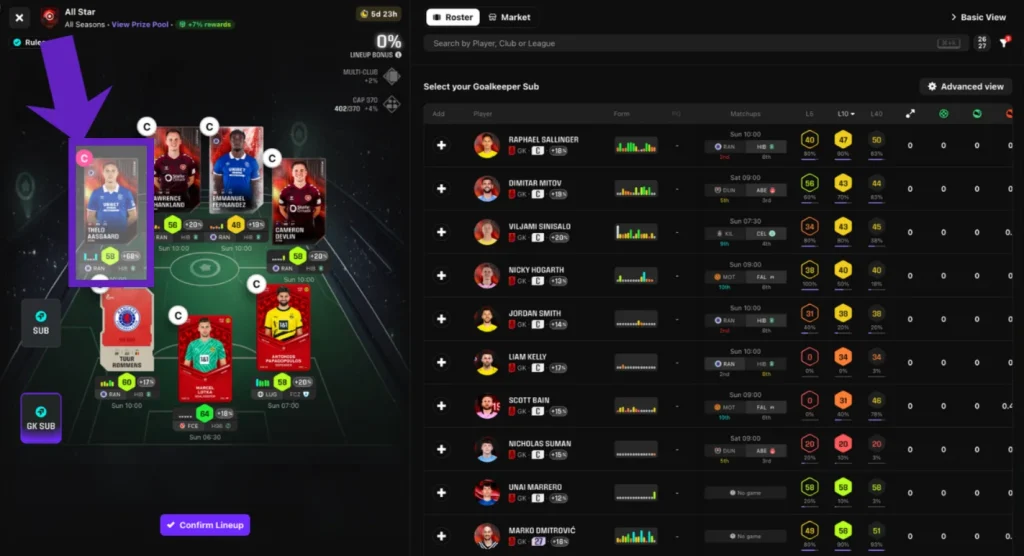
Here are some of my top rules for picking the right captain:
- Prioritize high-floor players: midfielders with strong all-around scores are ideal in risky matchups
- Look for set-piece takers and those with penalty duties
- Check predicted lineups and injury reports before confirming the choice
- Stack captain picks with good matchups – weak opposition boosts upside. Pick defenders likely to tackle well and keep a clean sheet, or forwards likely to score/assist who can also win a lot of duels
Independent fixture research
Fixture research is often ignored by casual managers… and that’s a mistake.
On your own, always check:
- Home vs away fixtures (players usually score better at home)
- Rotation due to midweek action in the Champions League, Europa League or the Conference League
- Opponent form (let’s say; last 5-10 games)
Evaluating the matchups
A great way to maximize your chances of good scores is the player matchup tool (also known as Player Grade) calculated by Sorare.
While setting your lineup, look for the “PG” column that I marked for you in the screenshot below.
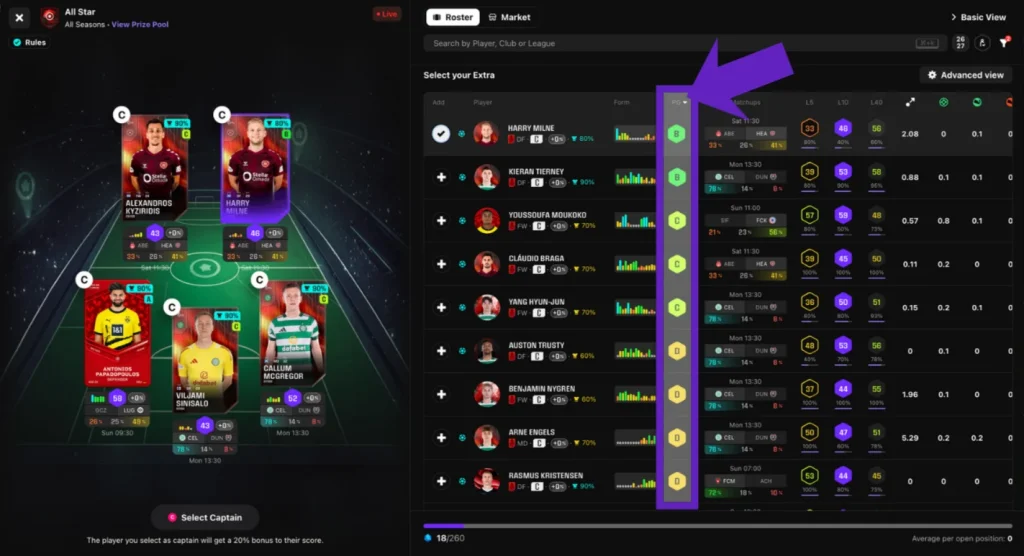
The ratings are the following:
- A – excellent matchup
- B – really good matchup
- C – good matchup
- D – average matchup
- E – fairly poor matchup
- F – poor matchup
This rating is Sorare’s way of estimating how favorable a player’s upcoming fixture is. It combines recent player performances with the strength of the opponent to generate a projected score before the match even kicks off.
Of course, football is unpredictable and no projection is ever guaranteed. However, the PG Matchup can be a useful tool when you’re deciding between two otherwise similar players.
How is the PG Matchup calculated?
Sorare doesn’t publish the exact formula, but the projection is built using Opta performance data and several important factors.
First, the system looks at the player’s recent form. Strong performances over recent matches naturally increase the projection, while poor form pushes it down.
Next comes the opponent. The algorithm evaluates how that team typically performs against players in the same position. For example, a striker facing a defence that regularly concedes goals and big chances is likely to receive a stronger PG Matchup than one facing the league’s best defensive side.
Finally, the venue also matters. Playing at home generally gives players a small statistical advantage, which is reflected in the overall projection.
Should you rely on PG Matchup?
I personally treat the PG Matchup as a helpful guide rather than a prediction of what will actually happen.
It’s excellent for comparing players with similar averages or deciding between two possible captain choices. However, I would never build an entire lineup based solely on this indicator (and neither should you 🙂 ).
Football always produces surprises, and recent form, confirmed lineups, injuries and tactical changes often have a much bigger impact than any projection model can fully account for.
How to Use Substitutions?

One of the biggest additions introduced with Sorare 27 is the new substitute system.
For years, one of the most frustrating parts of Sorare was the dreaded DNP (Did Not Play). You could build the perfect lineup, only to see one player unexpectedly miss the match because of a late injury, squad rotation or a last minute coaching decision. It happened to me on countless occasions!
Substitutes are designed to reduce exactly that problem.
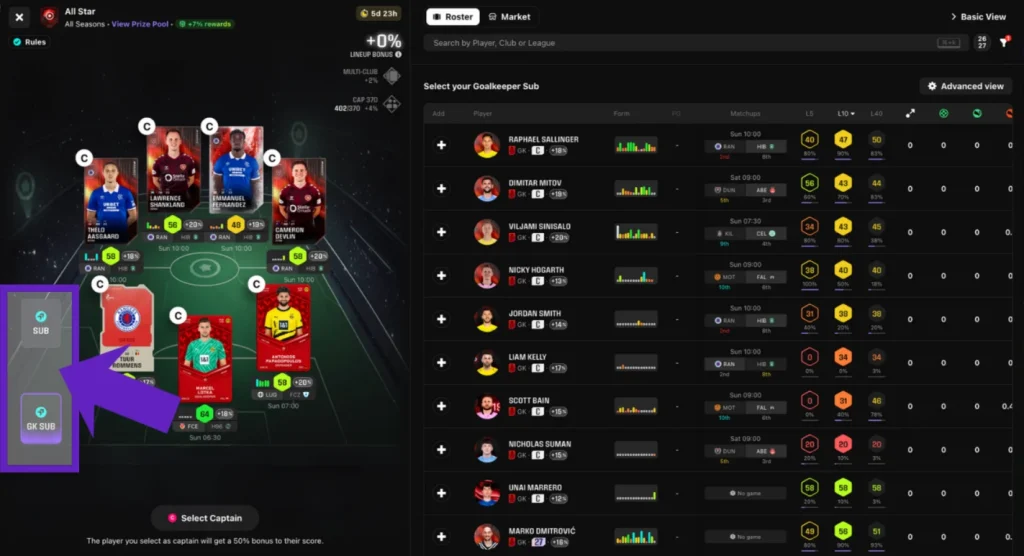
Every lineup you enter in Pro now includes two substitute slots. One is reserved for a goalkeeper, while the other is used for an outfield player.
Please refer to the screenshot below where I’ve marked the two sub slots while setting up my Classic lineup for the upcoming weekend.
How the substitute system works?
If one of your starting players doesn’t play at all, Sorare will automatically check whether you have an eligible substitute available.
For goalkeepers, the rule is simple. Your backup goalkeeper replaces your starting goalkeeper if he records a DNP.
For outfield players, the replacement must normally match the position of the missing player.
- If your defender doesn’t play and your substitute is also a defender, the substitute’s score replaces the missing player
- If your midfielder doesn’t play but your substitute is a defender, no substitution takes place because the positions don’t match
- If your forward misses the match, only a substitute forward can replace him
This makes choosing your substitute much more strategic than simply selecting your highest projected scorer.
There is one important exception to remember.
The last player in your lineup is the flexible extra outfield slot. If this player records a DNP, your outfield substitute can replace them regardless of position.
For example, imagine your extra player is a midfielder but your substitute is a defender. If that midfielder doesn’t play, the defender’s score will still count because the extra outfield slot accepts any outfield position.
This gives managers additional flexibility when building lineups and makes the substitute slot even more valuable.
For more detailed information on the subs, read my full guide to substitutions.
Card & Lineup Bonuses Explained

By now you know that your player can score between 0 and 100 points in the Sorare Scoring Matrix.
But how well your player scores in the Matrix is one thing and how much bonus points he can accumulate is another.
In Sorare 27, we differentiate between two main bonus types:
- Card bonuses – bonus % applied to individual cards. Includes Scarcity Bonus, In-Season Bonus, XP Bonus, Collection Bonus, Captain Bonus
- Lineup bonuses – bonus % applied to all cards in a given lineup. Includes Multi-Club and Cap bonuses
Below I’ll explain each bonus type individually.
Scarcity Bonus
Each card scarcity has its own bonus.
- Common – 0%
- Limited – 5%
- Rare – 10%
- Super Rare – 20%
- Unique – 50%
Here it’s important to note that although you can play your cards in scarcities below (eg. Rare in Limited competitions), in such cases the scarcity bonuses don’t apply. They’re only active if you play the card in the scarcity it belongs to. This ensures level playing field for everyone.
In-Season Bonus
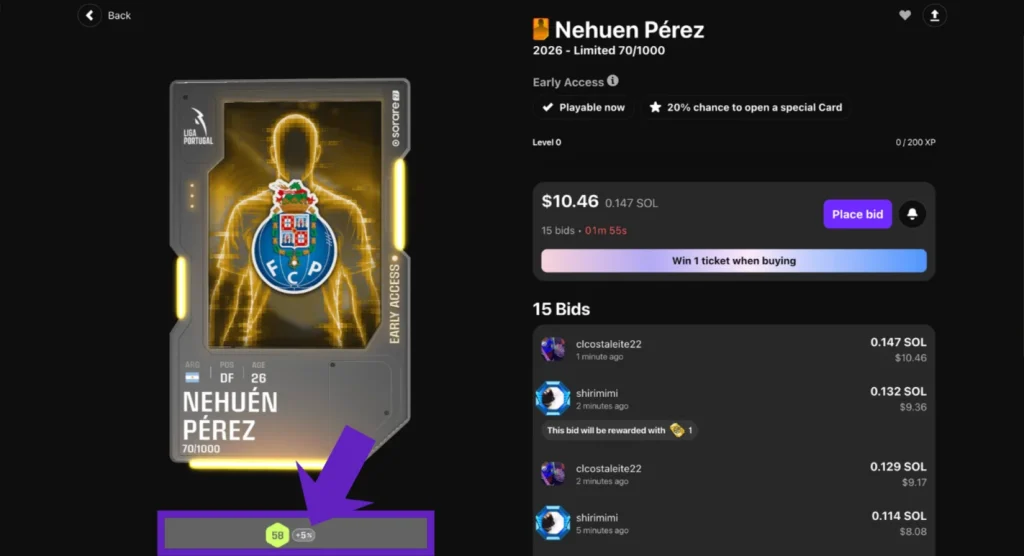
This bonus is a guaranteed 5% to everything your player scores and it applies to all In-Season cards.
Since all cards released for the current season will have this bonus, the upside is minimum – unless you plan to play your In-Season cards in Classic competitions (but this doesn’t make much sense from a financial standpoint).
XP Bonus
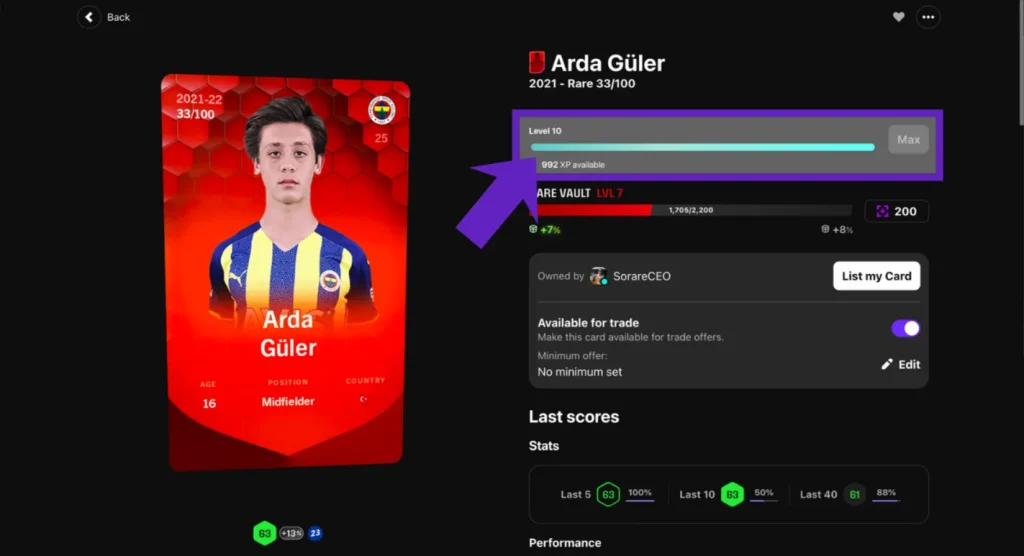
This bonus ranges anywhere from 0 to 10%. All Sorare cards have Levels ranging from 0 to 10 and each level gives you additional 1% in your bonus score.
I’m proud to show you below my Arda Güler Rare card which has already reached the maximum XP.
You can accumulate XP bonus in two ways:
- by playing your cards in lineups – for a 5-player lineup, the total base score (base score = without bonuses) of the lineup is divided by 5 and that’s the XP won by your card in the given Gameweek. It works analogically for a 7-player lineup – the total base score of that lineup is divided by 7 and each card gets an equal share of points.
- by applying XP boosts to your cards – pretty self-explanatory. You can level up your cards with XP boosts. As you already know, XP boosts are a form of rewards in some Pro competitions and also the Daily/Weekly Missions. You can win 200, 500, or 1000 boosts and stack them together.
It’s relatively easy to get to the first few levels but the higher the level, the more time – or a bigger XP boost – it will take to level up your card.
Take a look at the table below to better understand the XP levels on Sorare.
| Level | XP to next level | Accumulated XP | XP Bonus |
|---|---|---|---|
| 0 | 0 | 0 | 0 |
| 1 | 200 | 200 | 1% |
| 2 | 400 | 600 | 2% |
| 3 | 600 | 1200 | 3% |
| 4 | 1000 | 2200 | 4% |
| 5 | 1500 | 3700 | 5% |
| 6 | 2000 | 5700 | 6% |
| 7 | 3000 | 8700 | 7% |
| 8 | 5000 | 13700 | 8% |
| 9 | 7500 | 21200 | 9% |
| 10 | 10000 | 31200 | 10% |
Collection Bonus
Sorare Collection Bonus is a system built around assembling club-specific albums.

Each licensed club on Sorare has its own collection per season and rarity. By collecting cards from a specific team and season, you earn a Collection Score. The higher your score, the bigger the Collection Bonus applied to every player from that album in your lineups.
As an example, my Arda Güler card you see below contributes 30 points to the overall collection of Fenerbahce 2021-2022.
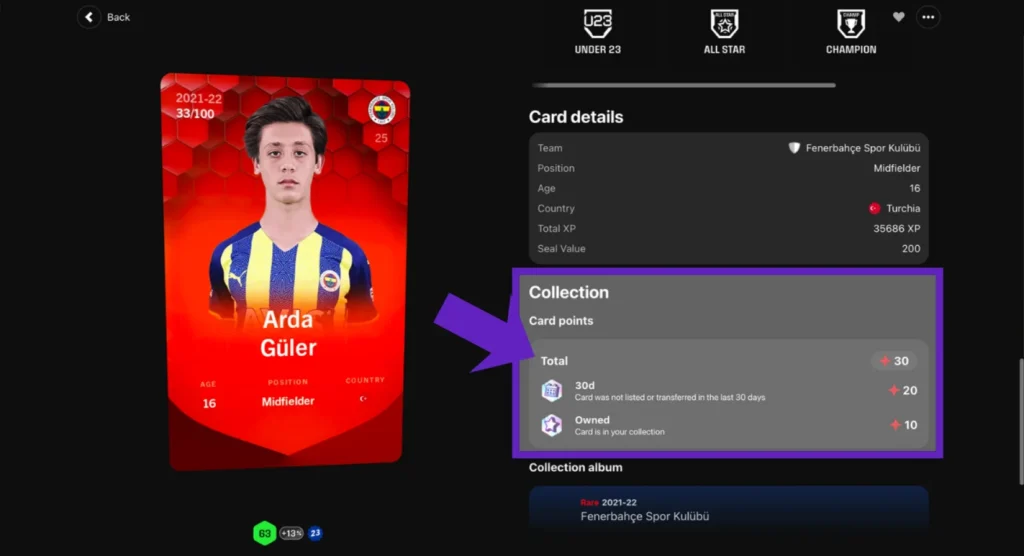
Each eligible card in a collection contributes points based on the following:
- 10 pts – Baseline (applies to all cards)
- 30 pts – #1 Serial or Jersey Match
- 20 pts – Special Edition
- 20 pts – first owner of the card
- 20 pts – the card hasn’t been listed on the secondary market for the last 30 days
| Album Total Score | Collection Bonus |
|---|---|
| 0 – 34 pts | 0% |
| 35 – 99 pts | 1% |
| 100 – 249 pts | 2% |
| 250 – 499 pts | 3% |
| 500 – 749 pts | 4% |
| 750+ pts | 5% |
Captain Bonus
As already touched upon in the lineup composition section above, this is a 50% bonus applied to the player card you select as your captain.
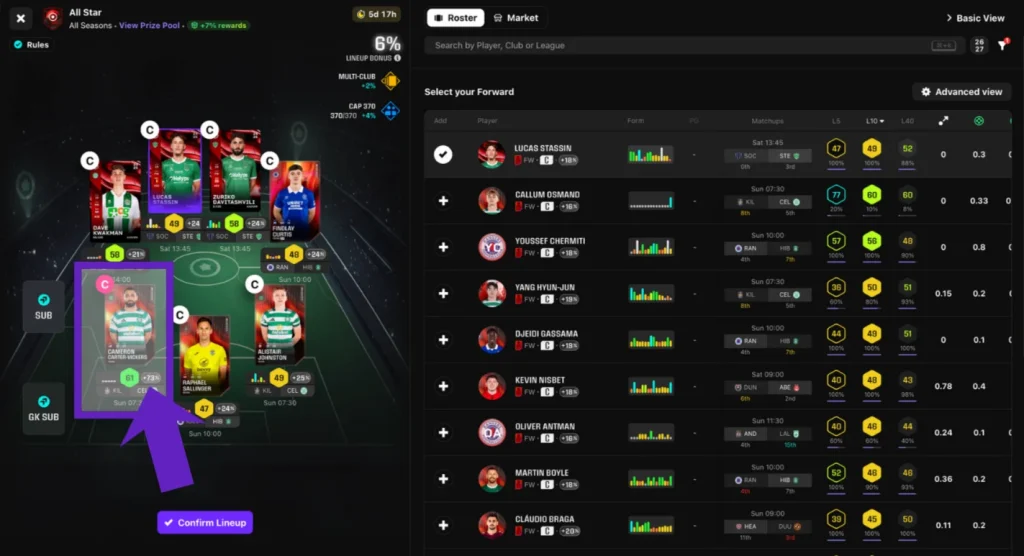
Please look at the screenshot above in which I’ve highlighted the player boosted with the captain bonus.
Lineup Bonus
There are two additional types of bonuses that apply not to individual players but to whole lineups (meaning = every player benefits).
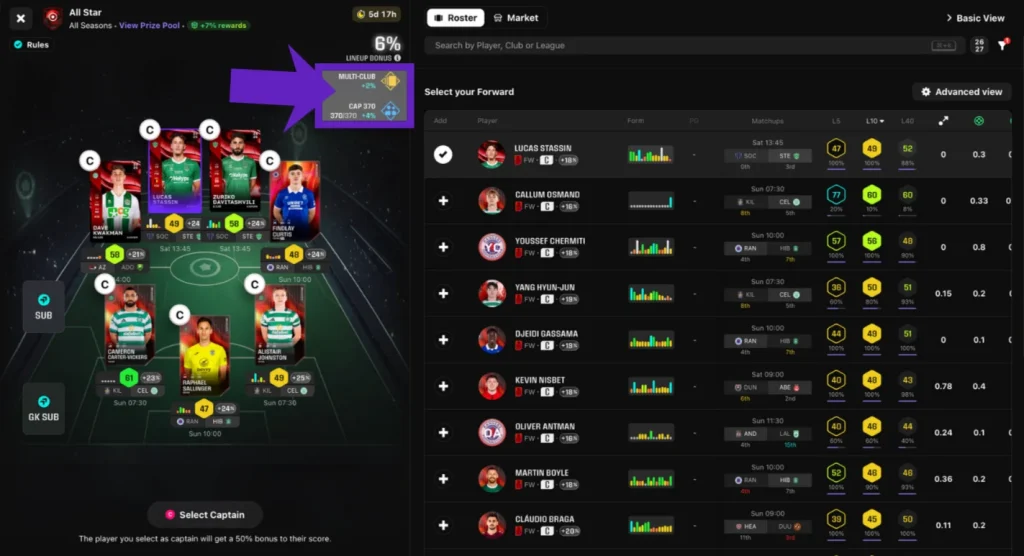
I’ve highlighted both bonuses in the image above.
The first one is called the Multi-Team Bonus.
It’s a lineup boost that rewards variety. To activate it, your team must include players from at least three or four different clubs, with no more than two cards from the same club.
If you qualify for the Multi-Club bonus, all the cards in your lineup will get an additional 2% boost.
The Cap Bonus gives your lineup a score boost if your team’s total L15 cap (average score over the last 15 games) stays under a set limit. The current cap equals 260 points for 5-player lineups and 370 for 7-player lineups.
It’s a reward for managers who build efficiently with budget-friendly players. Instead of leaning on expensive stars, this bonus encourages strategic depth and clever roster construction.
Important: Starting in Sorare 27, lineup bonuses apply exclusively to Arena (Pro or Classic) lineups.
Beginner’s Guide to Card Scarcities

| Scarcity | Best for | Budget |
|---|---|---|
| ⚪ Common | Learning the basics, free entry | Free |
| 🟡 Limited | New managers, casual gameplay | Low ($10–$100 to build a team) |
| 🔴 Rare | Core gameplay, better rewards | Mid ($10–$500+ per player) |
| 🔵 Super Rare | Advanced users | High |
| ⚫ Unique | Elite players, collectors, whales | Very High |
Card scarcity in Sorare is what sets the platform apart from traditional fantasy football games. Instead of using a shared player pool, you actually own individual cards. And only a fixed number of each player is minted per season!
These digital cards are categorized by rarity. Each tier has its own color, supply limits, gameplay restrictions, and reward access. The rarer the card, the more exclusive the tournaments and prize pools it unlocks.
In short, each next scarcity is more expensive because it allows you to compete against smaller number of people. You basically pay more to have a bigger chance of winning.
Common (Gray)

Commons are free-to-play cards that you. You’ll receive a set of them when you create your account and complete the onboarding process.
They’re perfect for beginners. They let you learn the rules, enter starter competitions, and get familiar with the platform without spending a cent.
Commons are non-tradeable and can’t be sold or entered into paid competitions. But they’re a great way to dip your toes in before deciding how much to invest.
Limited (Yellow)

Limited cards are the official entry point to Sorare’s paid ecosystem. Each player can have a maximum of 1,000 Limited cards minted per season (though Sorare often releases far fewer).
Most new managers start here. Limited cards are affordable, liquid, and ideal for building your first real squad. With newly-released version you can win cash, cards, or market credits just by finishing high on leaderboards.
Rare (Red)

Rare cards are the next tier up. They’re the gateway to Sorare’s higher-level gameplay. Each player has up to 100 Rare cards per season, making them 10x scarcer than Limiteds.
Rare cards unlock access to higher prize pools and are often required to enter competitions that offer bigger cash payouts and better Hot Streak bonuses. Most serious managers eventually transition here once they grasp the fundamentals.
Super Rare (Blue)

Super Rares are limited to just 10 copies per player per season. They’re high-cost, high-reward assets aimed at managers looking to dominate premium competitions.
They’re entered into merged competitions with Unique cards.
Unique (Black)

Unique cards are the rarest items on Sorare. Only one Unique is minted per player each season. That’s it. These cards are often collector’s pieces, high-level strategy tools, or trophies in themselves.
These cards are usually held by elite managers or deep-pocketed collectors.
Which scarcity to choose?
The scarcity that will be the best for you will depend on your budget, goals, and how you want to approach the game.
When it comes to my experience, over the years I’ve found the sweet spot lies in a blend of Limited and Rare cards. Here’s why:
- Affordability: You can build competitive teams without breaking the bank
- Flexibility: Rares allow entry into top-tier tournaments, while Limiteds fill roster gaps
- Liquidity: Both card types have healthy activity on the secondary market
Whether you’re flipping cards, chasing Hot Streaks, or building long-term collections, these tiers give you the most control and room to grow. I still use Rares weekly… and they remain the backbone of my strategy.
Learn more on the subject of rarity by reading my detailed article on Sorare scarcities.
Sorare Essence & Card Crafting for Newbies

Essence is a reward system that complements the platform’s card-based economy.
Essence isn’t tied solely to leaderboard ranking. Instead, it’s earned gradually across a wide range of game modes.
Once you’ve collected enough, you can use Essence to craft Sorare cards. These crafted cards are just like any other: fully playable, tradeable, and sellable on the secondary market.
Join Sorare with code SORARECEO to get free $150 for your first cards.
SORARECEO
COPY
SorareCEO.com is a certified affiliate partner of Sorare. This is an exclusive bonus for my readers.
You can also use Essence to enter the Arena tournaments! As already explained in this Sorare guide, these are the pay-to-enter mini-tournaments in which you compete against a smaller number of managers (usually 9).
Each card scarcity has its own Essence, meaning you will collect different colors of Essence depending on which cards you play with.
How to earn Essence?
Sorare allows you to accumulate Essence in nearly every part of the game:
- Daily/Weekly Missions: Complete objectives like scoring a decisive action
- Arena Rooms: Compete against 9 other players using Pro cards — win or finish in the top 3 to earn more Essence
- In-Season Arenas: On top of cash rewards, the In-Season tournaments also pay good number of Essence
- Classic Tournaments: While they don’t pay cash, they reward consistent players with cards and Essence
- Vaulting: Sealing unused cards into your vault gives you permanent multipliers on all Essence earnings
Because you earn it even when you don’t win the top leaderboard prizes, Essence is ideal for building your gallery steadily (especially if you’re still learning the game or building gallery depth).
How crafting works?
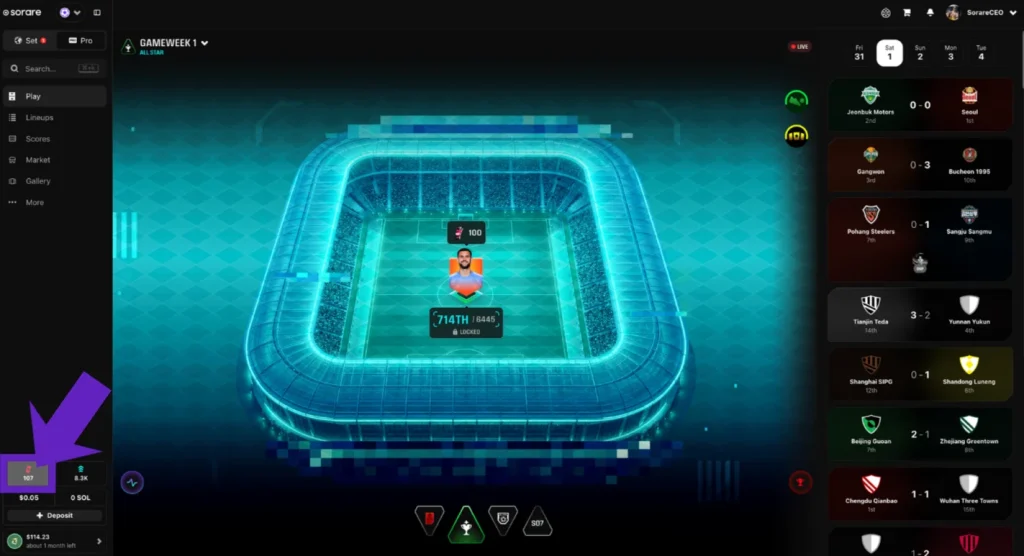
Crafting is the process of turning your saved-up Essence into a real card. Once you hit the required Essence threshold (1000 Essence), you can enter the crafting menu and draw a new card for you gallery.
Once you reach the minimum amount of Essence required to craft, you can navigate to the crafting machine by clicking on the Essence icon marked for you in the screenshot below.
To start crafting, swipe the button I marked for you below. Good luck!
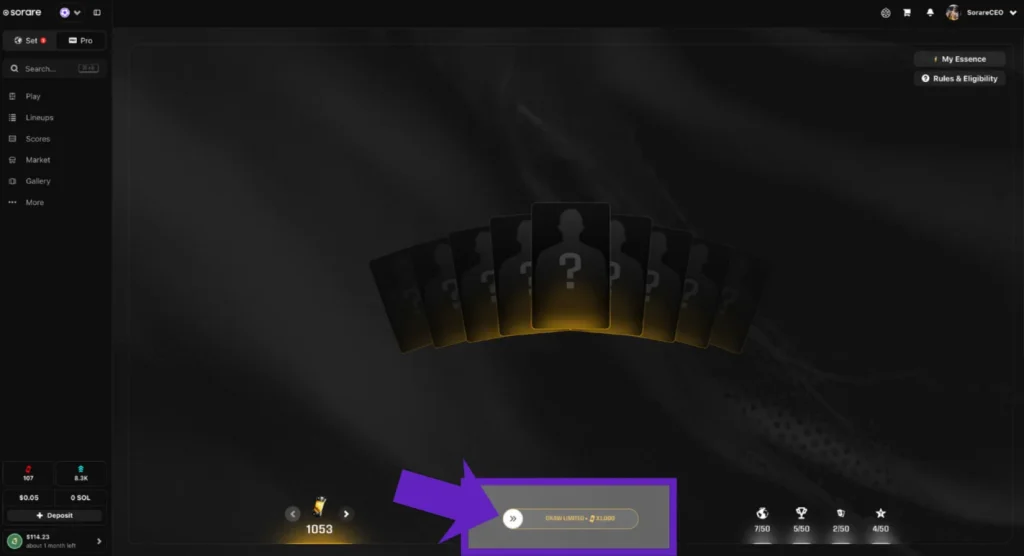
After hitting the “Craft” button, 10 cards will appear on your screen – face-down. Here you can immediately pick one of the cards to reveal it, or spend more Essence on additional clues, eg. the nationality of the player, or the club/league he plays in.
You can either keep the card, or – in case you’re not happy with it – return it for 200 Essence (as seen below).
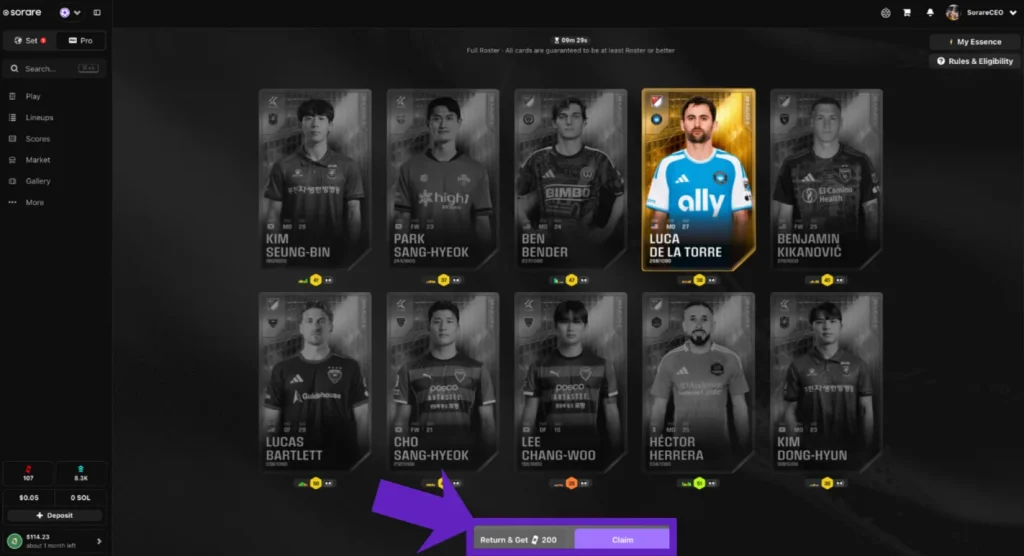
To sum up, Essence and crafting give you another path to success. If you’re entering lineups consistently but falling just short of the main prizes, crafting is an alternative way to improve your card gallery. Over time, you can accumulate enough Essence to craft multiple cards per month or even per week (like I do now 🙂 )
Demystifying the Card Vault

The Vault is Sorare’s version of a burn-and-reward system. You take cards you’re no longer using and lock them away permanently. In return, you earn something even better: vault points.
These points accumulate and unlock passive reward multipliers on:
- Cash payouts from competitions
- Market credits earned through rewards
- Essence
The Vault Levels range between 1 and 20. Level 1 gives you 1% boost on all your rewards, while Level 20 improves your winnings by 20%.
In simple terms: the more you vault, the more rewards you earn going forward across the entire platform.
Check the table below for the exact reward boost you will get based on your Vault level.
| Level | Boost | Total Sealing Points Needed |
|---|---|---|
| 1 | 1% | 20 |
| 2 | 2% | 50 |
| 3 | 3% | 300 |
| 4 | 4% | 400 |
| 5 | 5% | 1,000 |
| 6 | 6% | 1,500 |
| 7 | 7% | 2,000 |
| 8 | 8% | 3,000 |
| 9 | 9% | 4,000 |
| 10 | 10% | 5,000 |
| 11 | 11% | 6,000 |
| 12 | 12% | 7,000 |
| 13 | 13% | 8,000 |
| 14 | 14% | 9,000 |
| 15 | 15% | 10,000 |
| 16 | 16% | 11,000 |
| 17 | 17% | 12,000 |
| 18 | 18% | 13,000 |
| 19 | 19% | 14,000 |
| 20 | 20% | 15,000 |
How to vault cards?
Inside your Sorare gallery, there’s a dedicated vaulting interface. Here’s the process:

- Select a card you no longer use – maybe a benched backup, retired player, or out-of-season piece
- Choose to seal it
- That card is now gone. No selling. No using. You can unseal just 1 card per 14 days.
- In return, you receive vault points based on the card’s value. The more valuable the card, the higher the vault points
Who should vault cards?
At first glance, vaulting looks like something only big-time managers do… the ones with hundreds of cards and disposable depth. But the truth is, anyone with a growing gallery can benefit.
If you’ve played for more than a few months, you probably have:
- Old cards whose teams got relegated
- Players who lost their starting role
- Cards you regret buying and can’t find a seller for
Instead of letting them rot in your gallery, seal them and get compounding value in return. You’re not just cleaning house… you’re boosting your future earning power 🙂
Tutorial on How to Buy, Sell & Trade Cards

Playing in tournaments is one way of utilizing Sorare but card trading is equally important (well, at least judging by my own experience).
It’s important to know where and when to buy/sell cards.
How to buy cards on Sorare
Just like I mentioned earlier in this Sorare guide, to start competing in top-tier tournaments filled with cash and card prizes, you will have to start assembling a team of scarce cards (Limited, Rare, Super Rare or Unique). The easiest tournaments to get in that also require the smallest investment (recommended for new players) are the Limited Card tournaments.
So, how to get cards in Sorare?
There are four ways you can acquire Limited cards on Sorare (or any other scarcity for that matter).
- New Card Auctions
- Instant Buys
- Manager Sales
- Direct Offers
Let’s go through all options below.
New Card Auctions & Instant Buys
The New Card Auction market is the place where you will find all the freshly-minted cards from the most recent season. This means that you will be the first owner of any card you get from this market.
The price of these player cards starts at roughly $2 but can quickly skyrocket depending on how popular the player is, how good the card looks, and whether it’s eligible for upcoming games. The auctions last for anywhere between a couple of hours to even a few days.
New Auction Market can be a source of great bargains. Most of the time, it’s possible to buy cards cheaper than on the Instant Buy market which is a convenient one-click purchase option.
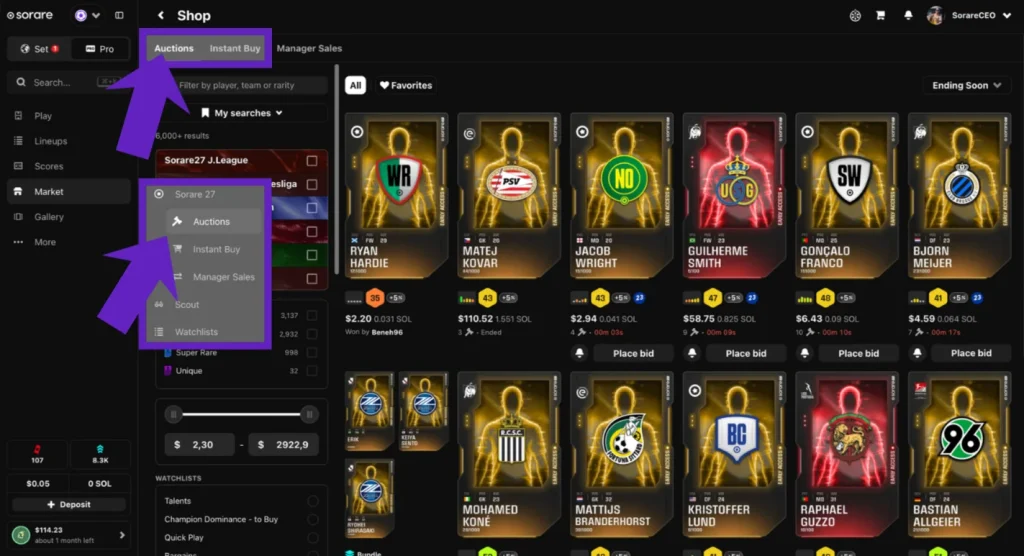
In the picture above I’ve highlighted the tabs you need to click to navigate to the Primary Market.
Since all the cards in the Auction & Instant Buy market are from the current season, they all come with a guaranteed multiplier bonus of between 5%.
Manager Sales
Manager Sales are part of the Secondary Market where you can buy cards from the current and previous seasons. These are pre-owned cards that are put up for sale by their current owners.
Navigate to Manager Sales by clicking the tab highlighted below.
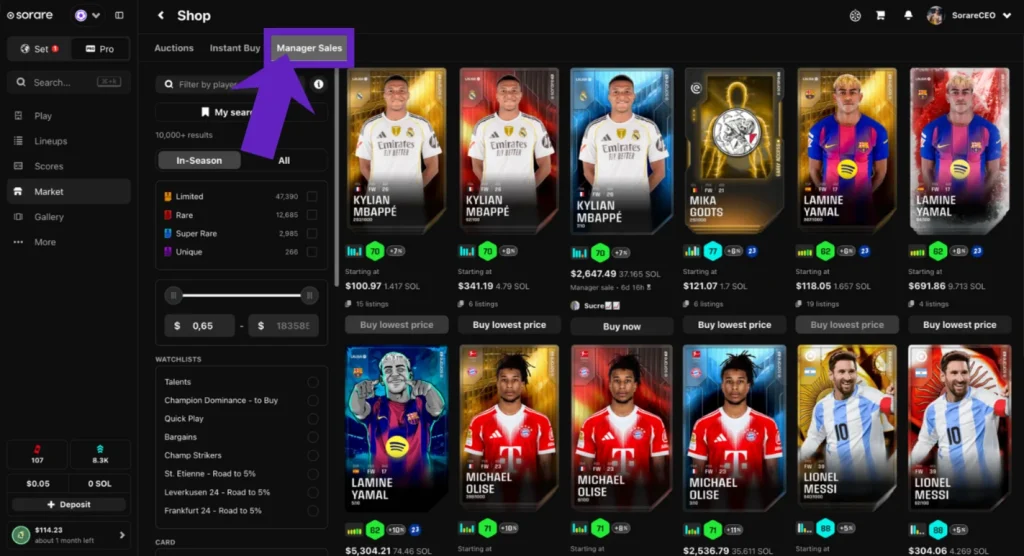
Here the prices depend on various factors such as a card’s scarcity, season, and accumulated XP. Usually, cards from previous seasons are cheaper than the current season’s cards because they don’t have the same multiplier bonus and they’re not eligible for In-Season competitions (well, you can have only 1 Classic card out of 5 cards in your lineup).
The good thing about Manager Sales is that you can buy any card you want without having to wait for an auction to end. Secondary market cards are also likely to be cheaper since they offer less Collection points.
Direct Offers
If the particular player you’re looking for isn’t currently available on the New Card Auction market or via Manager Sales, you can always make a Direct Offer to any owner and see if he’s willing to sell the card.
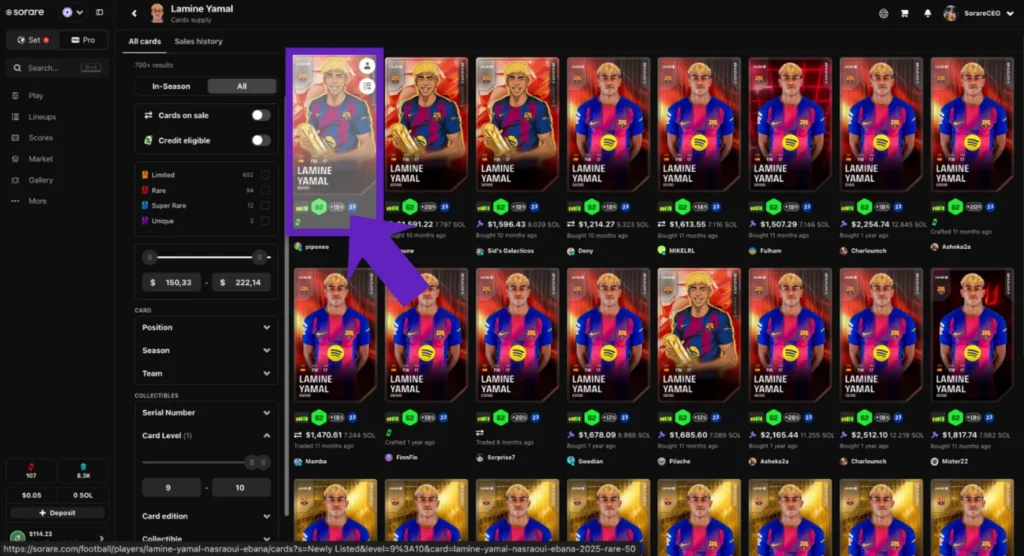
All you have to do is type the player’s name in the search bar and then on the player’s page select “Card Supply” (see the image below).
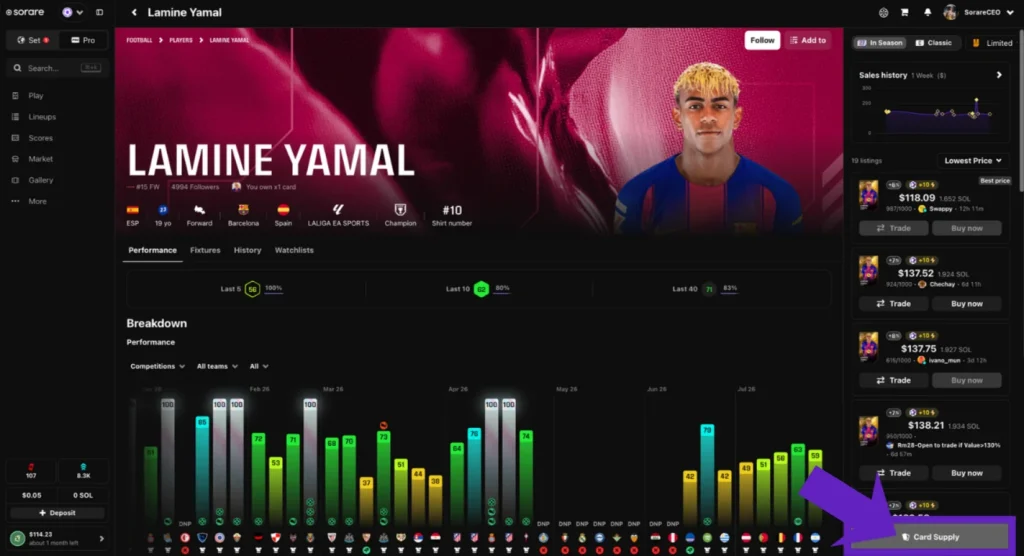
Now, click on any card you wish to send offer for.
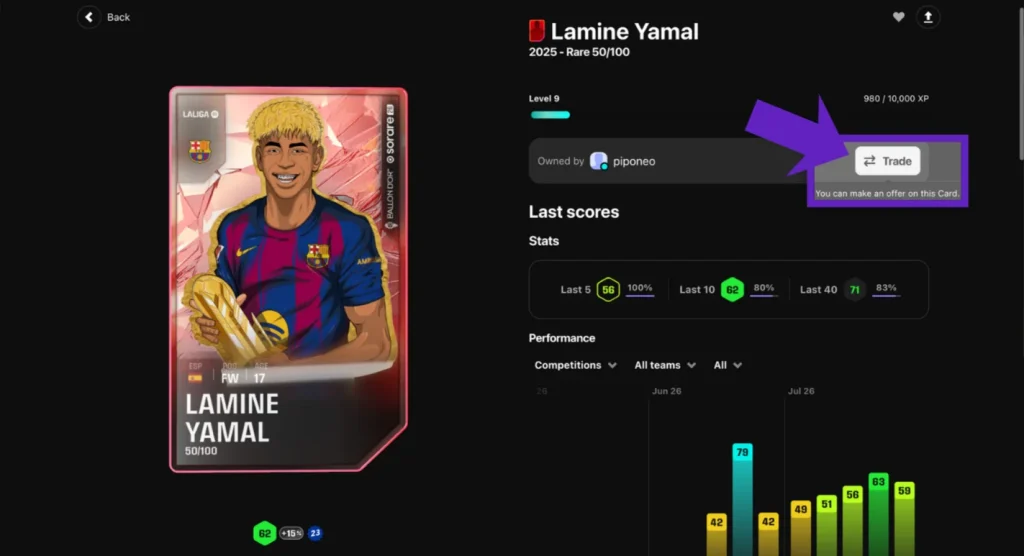
On the card’s page, you will see a “Trade” button and that’s where you can send a direct offer to the owner.
Finally, confirm the price you’re willing to pay for the card and click “Send the trade”.
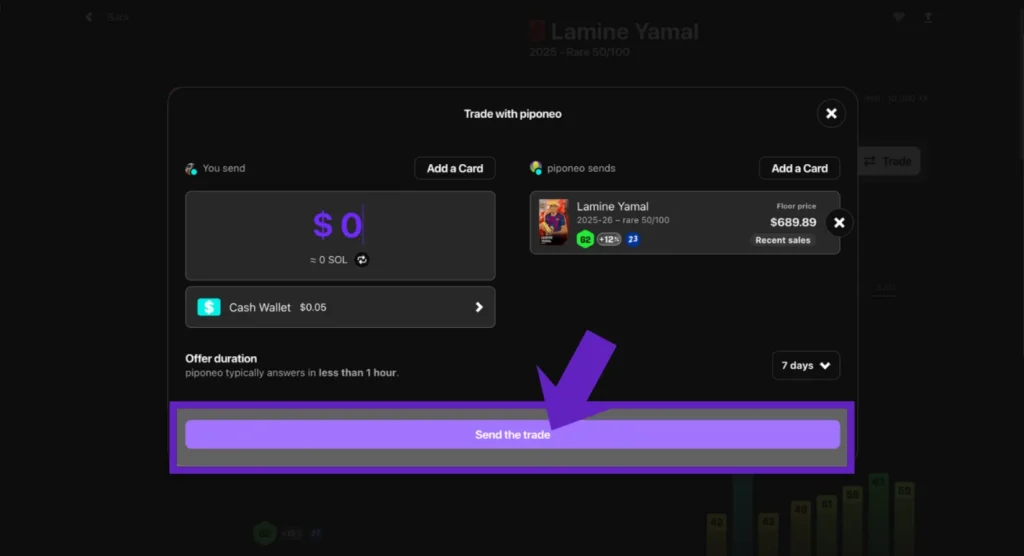
Now it’s time to wait for the card owner’s response 🙂
How to sell Sorare cards
Alternatively, you can also put your card(s) up for sale in the Secondary Market. This is a great way to get some of the funds back and also get rid of cards that you don’t want to use anymore.
Or maybe, just maybe, your player has found brilliant form and you want to make a massive profit on the back of his great performance.
So, how to sell a card on Sorare?
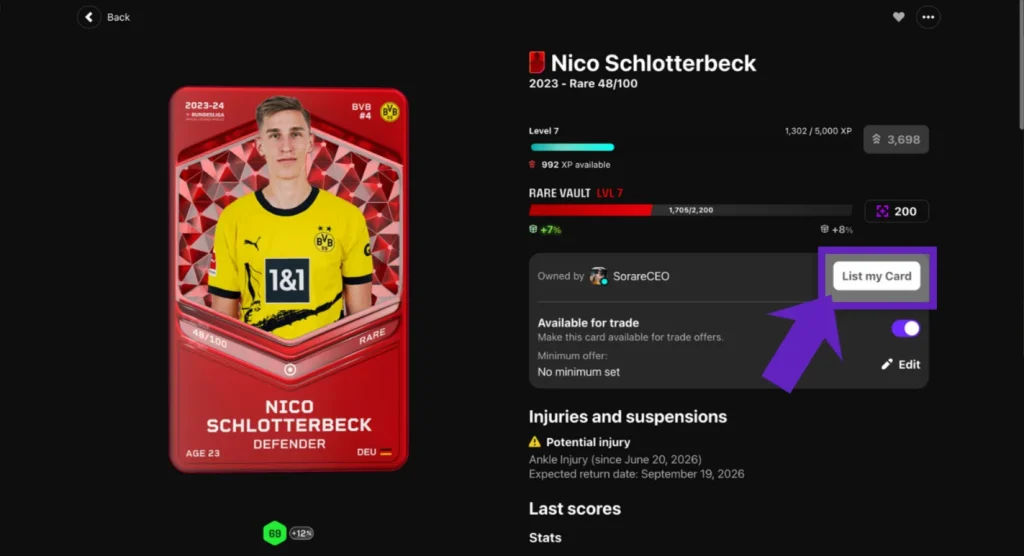
To do this, you will have to navigate to “Gallery”. Now all you have to do is click on the player’s card you wish to sell (see the screenshot below).
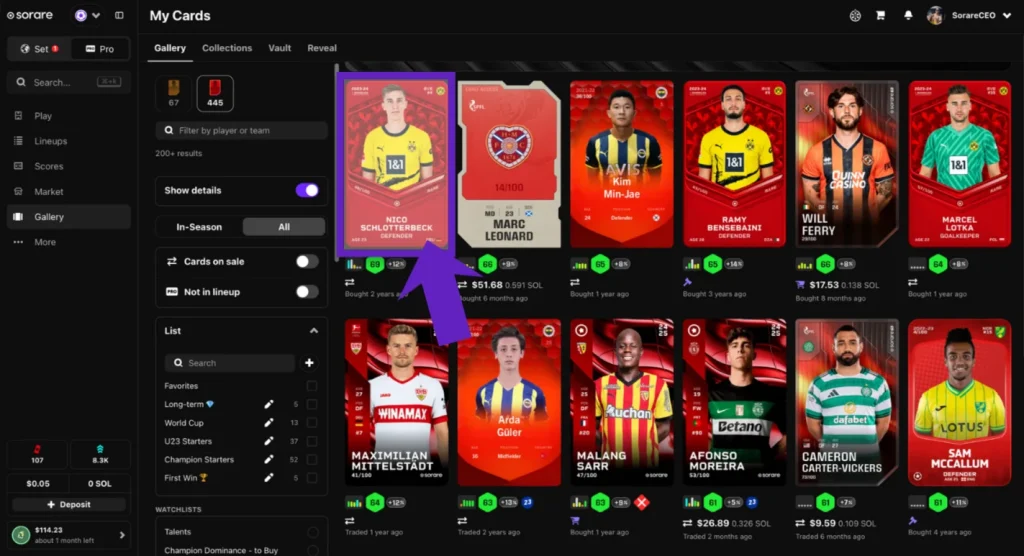
Let’s assume that I indeed want to sell my Nico Schlotterbeck card (which I don’t 🙂 ). Once on the card’s page, click the “List my Card” button I highlighted for you below.
Finally, you set the price and confirm the listing by clicking “List”. All the cards you put on sale are listed for 7 days by default (you can shorten that to anywhere between 1 and 6 days).
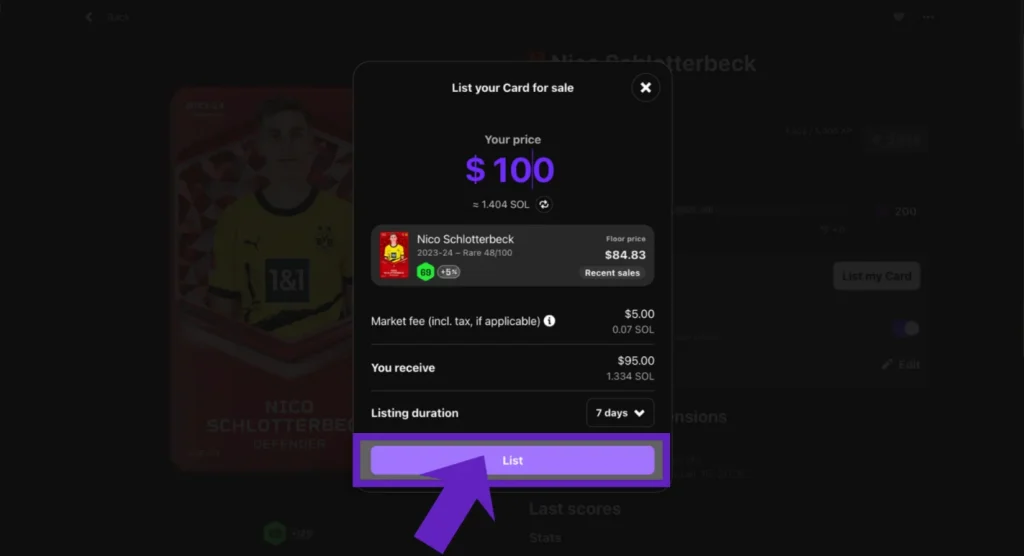
If nobody fancies paying the price you’re asking for, the card will return to your gallery and you’ll be able to list it again (maybe for a lower price this time).
What’s also important to note, should you change your mind during the duration of the listing, you can always cancel the sale at any time. As of now, canceling listings before planned expiration doesn’t come with any fee or penalty.
Keep in mind that it’s important to list your card at a competitive price since there are many other sellers in the market as well.
💡 Important to know: If your card sells, there’s a 5% transaction price which goes into Sorare’s pockets.
Trading tips
Apart from competing for weekly cards and cash prizes, trading is another way many beginners use Sorare for generating profits. Below you can get familiar with some of the basic trading strategies practiced regularly by thousands of Sorare managers.
Like with any type of trading the golden rule is to buy low and sell high. However, that is easier said than done especially when it comes to Sorare.
So how can we maximize our chances of scoring a bargain and then selling it for a huge profit?
Well, first you need to understand that the price of Sorare cards depends on the demand. Normally, the higher the performance of the player, the bigger the demand and consequently the price.
So what type of players to invest in, when to invest in them, and when to sell?
Investing in injured stars
One of my favorite strategies for successful trading on Sorare is investing in star players that are currently out of the game because of injuries.
Kylian Mbappe is a great example of such a player. When fit, there’s no way he’s left on the bench. Considered one of the best players in the world, the French International has a guaranteed starting place in basically any football team in the world.
The strategy of investing in injured players is profitable but only when it comes to medium-term injuries. That’s because if a player misses a single game, the price difference will be minimal. On the other end of the spectrum, you don’t want to target players that will miss most of the season since their price is likely to take a massive hit after the card turns from In-Season (competing for money prizes) to Classic (competing for cards).

Once the player is back from injury, you can list it on the secondary market and count on really good profits.
Investing in young talents
If you are fine with the idea of long-term trading, a solid strategy is to invest in young talents that are at the gates of first-team football.
If you have good knowledge about a particular league and are familiar with all its biggest talents that are not playing regular first-team football yet, you are at an advantage.
Promising young players come with the Under 23 sticker and are highly valued because of their long utility in the game. Once they start participating regularly in the first team, their prices will skyrocket and that will be the perfect moment to sell.
Investing in players about to change clubs
Those of you who are into transfer gossip or have credible sources in the game can be a step or two ahead of the rest of the market.
Players who you should be monitoring are those who are rumored to be leaving in the near future.
But not all transfer deals will be profitable for Sorare managers. A player’s price will increase only if his chances of scoring high points after the transfer will increase.
The two most popular scenarios in this case are:
- The player leaves a medium-to-bottom tier club and moves on to a top club in the same league (ie. moving from Southampton to Manchester City)
- The player leaves a strong league and moves to a club from a lesser league where scoring high points is easier (ie. moving from Chelsea to Rangers)
In the ideal scenario, you should buy the players just before it becomes common knowledge that the transfer will happen, and sell them just when the deal is announced.
Investing in backup goalkeepers
Goalkeepers are the most sought-after players in the game because their number is much more limited.
While players in other positions are in the tens of thousands, most of the teams only have two to three goalkeepers in their ranks.
Hence, it’s a good idea to invest in backup goalkeepers and sell them when the first-choice keeper gets injured, serves a suspension, is about to change clubs, or has simply lost his place because of poor form.
End-of-season purchases
When a particular season comes to an end, the prices will drop as well.
You can buy such cards during the so-called end-of-the-season discount phase and resell them for likely profit once the season restarts.
Final Word

Hopefully, this Sorare tutorial has given you a good overview of what the platform is all about and how you can get started with it.
To sum up, Sorare is a fantasy sports game that uses digital cards of mostly football players. The game is free to play but you will need to buy some scarce player cards in order to participate in tournaments with cash and card prizes.
The cards can be bought in the Primary Market (New Card Auctions and Instant Buys), as well as Secondary Market, or won as prizes in weekly tournaments.
The aim of the game is to score points by playing your cards in weekly matches. The more points you score, the higher up the leaderboard you’ll climb and the bigger the rewards.
If you’re looking for a fun and unique way to get into fantasy sports and revive your love for football (or NBA or MLB), then Sorare is definitely worth checking out!
Join Sorare with code SORARECEO to get free $150 for your first cards.
SORARECEO
COPY
SorareCEO.com is a certified affiliate partner of Sorare. This is an exclusive bonus for my readers.
I made sure to get the subject of Sorare explained in the best way possible. However, if you feel this Sorare guide is missing any information, feel free to drop me an email and I will get back to you/update the article as soon as possible. Alternatively, feel free to read my Sorare review for additional clues.