


Sorare cards are at the center of almost everything you do with your club. You use them to build lineups, enter competitions, collect players, earn rewards, and trade with other managers.
But if you’re new to Sorare, the card system can look more complicated than it really is.
You have Common, Limited, Rare, Super Rare, and Unique cards. Then there are In Season and Classic cards, XP, levels, bonuses, serial numbers… and prices that can change considerably between two cards of the same player.
I had to learn all of this when I started playing Sorare in 2022. Some parts made sense immediately. Others only became clear once I started buying cards, building lineups, and making a few (questionable) purchases of my own.
So in this guide, I’ll explain Sorare cards from the ground up. We’ll look at card types, scarcities, seasons, XP, prices, ownership, buying and selling, long term utility, and what actually happens to your cards as the years pass.
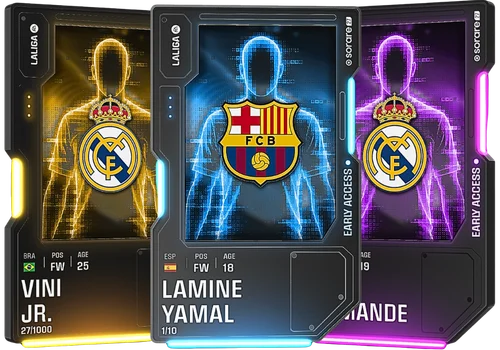
Join Sorare with code SORARECEO to get free $150 for your first cards.
SORARECEO
COPY
SorareCEO.com is a certified affiliate partner of Sorare. This is an exclusive bonus for my readers.
What Are Sorare Cards and How Do They Work?

Sorare cards are digital cards representing real professional athletes. In Sorare Football (the game also supports NBA and MLB) which I personally focus on, each card connects to a real footballer and can have a practical role within your fantasy club.
That last part is important. Sorare cards aren’t simply digital pictures you collect. Depending on the card and competition, you can use them in lineups, earn rewards with them (that include cash), and trade with other managers.
This combination of fantasy utility and collecting is what makes the card system central to Sorare.
What does a Sorare card represent?
Every Sorare card represents a specific footballer. However, several different cards can exist for the same player.
A player can have cards from different seasons, clubs, editions, and scarcity levels. Collectible cards also have individual serial numbers, so two managers can own cards of the same footballer without owning the same digital collectible.
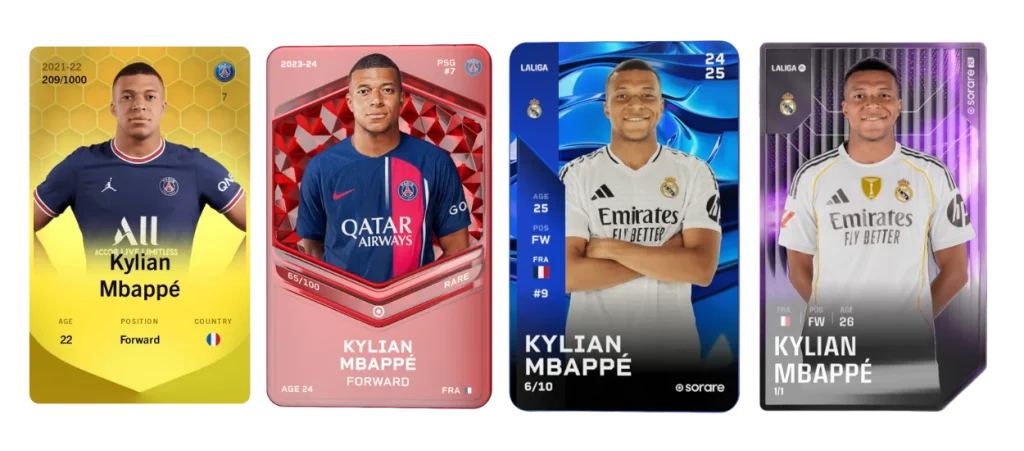
You can even own several cards of one player yourself but you can’t use them in the same lineup. I own a few duplicates of players that I think are simply too good to have only one copy of 🙂
But for now it’s important to know that the crucial thing is always the real footballer behind the card. His performances on the pitch determine what happens when you use an eligible card in fantasy competitions.
Using Sorare cards in fantasy lineups
Gameplay is the main reason I own most of my cards. Sure, I do keep some of them just because they mean something more to me but I’d say that 99% of the cards in my gallery are there to help me win and progress my Sorare club.
You use eligible cards to build fantasy lineups for Sorare competitions. Which cards you can select depends on that competition’s rules, including requirements around positions, scarcities or seasonality.
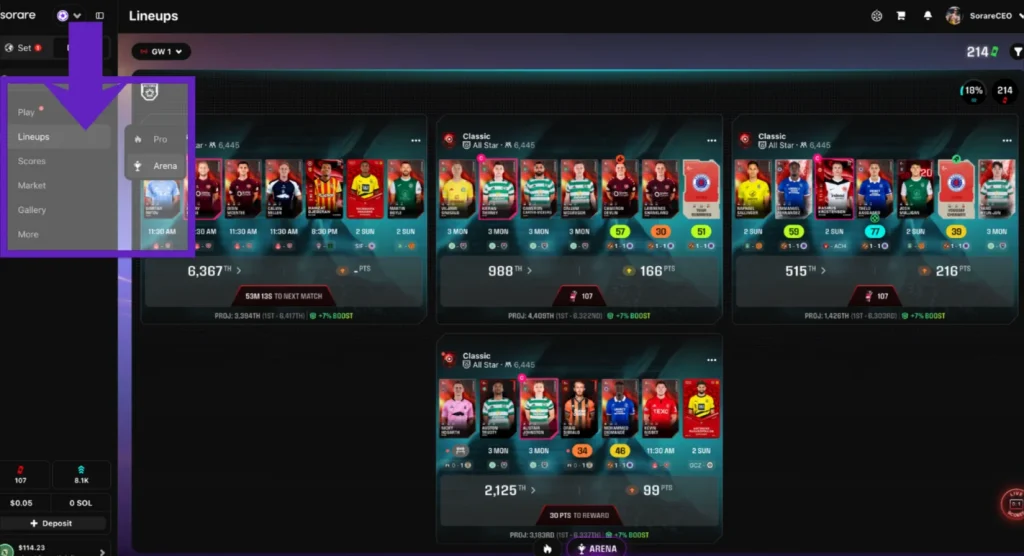
This means owning a great footballer isn’t enough on its own. You need a version of his card that actually fits the competition you want to play.
I learned to think about cards this way quite early after joining in 2022. A famous player sitting unused in my gallery isn’t necessarily more valuable to my club than a less famous starter I can use every week.
Cards track real-life performances of players
Once you submit a lineup, Sorare follows the real matches played by the footballers represented by your cards.
Their actions on the pitch generate fantasy scores. Goals and assists matter, but Sorare also considers many other actions depending on the player’s position and overall performance.
Your card then contributes that player’s score to your lineup, including any applicable card bonuses.
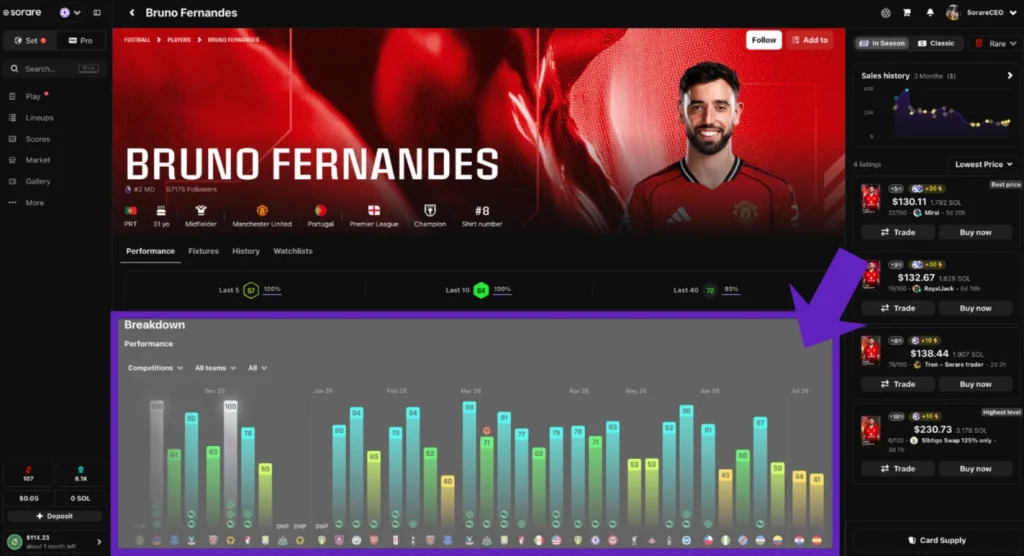
There are no simulated matches behind this process. If your midfielder has a great match on Saturday, your lineup benefits from what actually happened on Saturday.
If he gets sent off, performs badly, or doesn’t play… you feel that too 🙂
That’s why Sorare changed the way I watch football. A match I would normally ignore can suddenly become very interesting when one of my cards are involved.
The ownership aspect
Collectible Sorare cards differ from simply selecting a footballer in a traditional fantasy game.
If you choose a player in Fantasy Premier League for example, you’re using that footballer within your fantasy squad. You don’t own a separate collectible representing him.
When you acquire a collectible Sorare card, that specific digital card becomes part of your collection. You can keep it, use it when eligible, sell it, or trade it with another manager.
Since Sorare cards are by definition NFTs (Non-Fungible Tokens), they are trackable on a blockchain and because of this their ownership is real and easily verifiable. Treat them as Panini cards & stickers but in the online world.
As you can see in the screenshot below, the ownership of my Julian Brandt Rare card is easily verifiable.
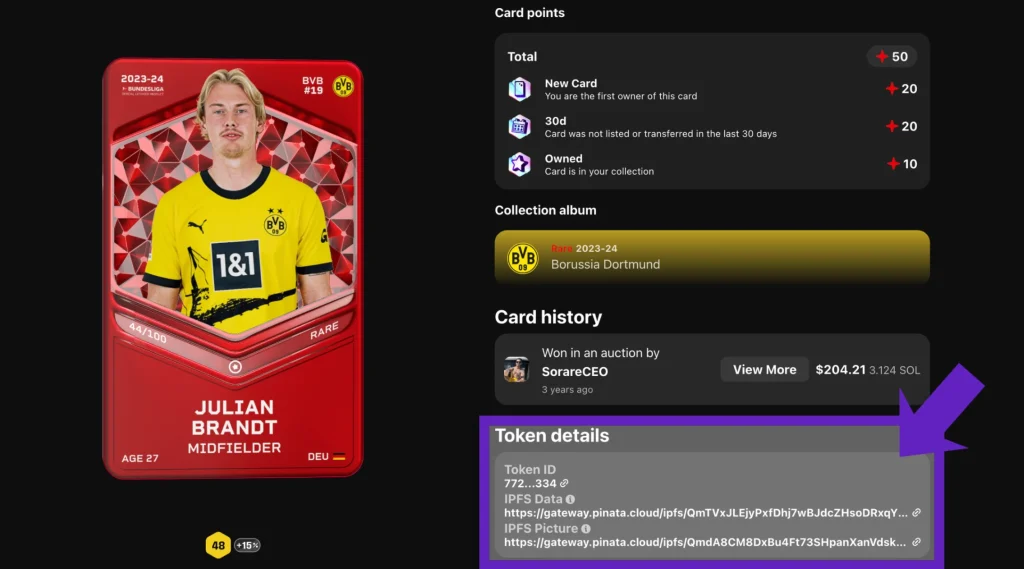
Using the card in a Game Week doesn’t consume it either. Once the competition finishes, the card remains in your gallery and can be used again.
Your ownership can also continue when a new football season begins or the player changes clubs. What may change is the card’s competition utility, something we’ll cover properly later.
Card Types and Scarcities

Sorare has two card types: non-tradable free-to-play Common cards and Pro Cards.
Scarcity tells you how limited the supply of a particular card can be.
You can recognize each type by color (and that’s probably the easiest way to do so for a beginner). Common cards are grey, Limited are yellow, Rare are red, Super Rare are blue, and Unique are black.
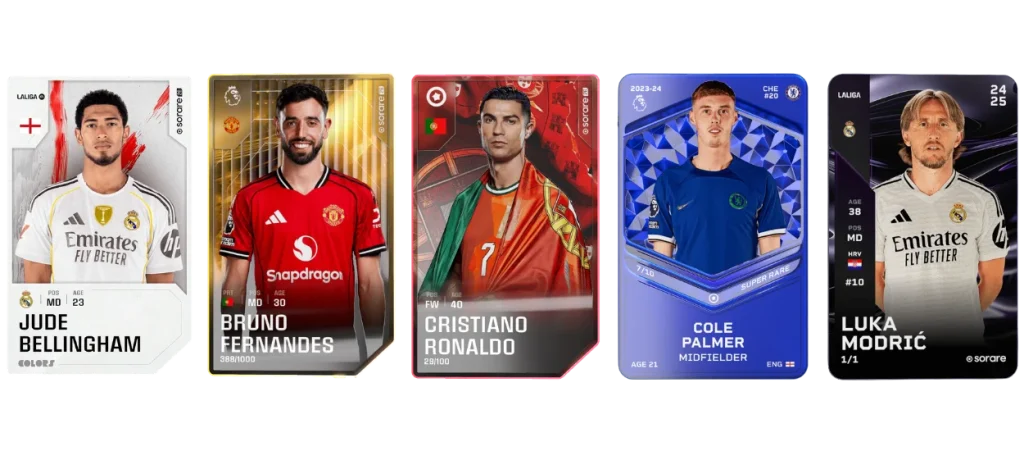
The same footballer can have cards across several of these levels. They still represent the same player, but their supply, bonuses, market value, and competition utility can differ.
Common cards
Common cards are free gameplay cards rather than tradable collectibles. They give new managers a way to build a collection and start playing without immediately spending money. They’re used in Sorare’s free-to-play mode – Arcade Sets.
You cannot sell Common cards to another manager like Limited, Rare, Super Rare, or Unique cards.
For beginners, they’re useful because they allow you to learn how Sorare works before deciding whether the collectible side interests you.
Limited, Rare, Super Rare, and Unique cards
The remaining four scarcities are collectible cards with increasingly limited supply.
- Limited: up to 1,000 cards of a player per season.
- Rare: up to 100 cards of a player per season.
- Super Rare: up to 10 cards of a player per season.
- Unique: only 1 card of a player per season.
Limited therefore has the largest supply among collectible cards. Unique sits at the opposite end, with only one seasonal card available for each player.
This doesn’t mean a Rare card is simply a Limited card with fewer copies. Different scarcities can have different competition utility and card bonuses, which gives managers practical reasons to choose one over another.
Price usually changes significantly too. Higher scarcity means fewer available cards, although scarcity alone never determines what a card is worth.
Supply differences
The easiest way to understand the system is to imagine one footballer receiving cards at every collectible scarcity during a season.
Sorare could issue as many as 1,000 Limited cards of him, but only 100 Rare, 10 Super Rare, and one Unique.
Move one level upward and supply drops sharply.
| Scarcity | Best for | Budget |
|---|---|---|
| ⚪ Common | Learning the basics, free entry | Free |
| 🟡 Limited | New managers, casual gameplay | Low ($10–$100 to build a team) |
| 🔴 Rare | Core gameplay, better rewards | Mid ($10–$500+ per player) |
| 🔵 Super Rare | Advanced users | High |
| ⚫ Unique | Elite players, collectors | Very High |
That limited supply matters because managers and collectors can compete for the same cards. If many people want a player’s Rare card but very few owners want to sell, availability can become tight.
Still, I wouldn’t automatically assume that a scarcer card is the better card for your club.
Personally I focus entirely on Limited and Rare scarcities mostly because of budget reasons and the competitions I can enter with them (eg. Hot Streaks). When I choose between these two, I first think about what I want to play. If a Limited card gives me exactly the competition utility I need, buying a Rare version simply because it is scarcer doesn’t improve my strategy (and probably costs me more as well).
Scarcity should serve a purpose.
💡 For now, remember the basic hierarchy: Common → Limited → Rare → Super Rare → Unique. The further you move through the collectible tiers, the lower the available seasonal supply becomes.
You can learn more by reading my guide to Sorare card scarcities.
Understanding Your Sorare Card

Two Sorare cards showing the same footballer aren’t necessarily identical. Season, scarcity, serial number, XP, level, and bonuses can all differ between individual cards.
You don’t need to inspect every detail whenever you open your gallery. But before I buy a card, I want to know exactly which version I’m looking at and what that version offers.
Season and In-Season status
Every collectible card belongs to a particular seasonal issuance. This tells you when Sorare released that version of the player.
A card can also have In Season status when it belongs to the relevant current season. This matters because many competitions specifically require In Season cards.
In Season cards also receive a 5% New Season Bonus while that status remains active.
Don’t confuse In Season with the date you bought the card. Buying an older card today doesn’t make it In Season. The status belongs to the card itself.
Eventually, an In Season card becomes Classic. We’ll cover exactly when that happens, and what it means for the card, in the next section.
Serial number
Collectible cards have individual serial numbers within their issuance.
For example, a Limited card could be number 25 from that player’s seasonal Limited supply. Another manager might own number 26 from the same issuance.
Below you can see where the serial number is for my Nico Schlotterbeck Rare card.
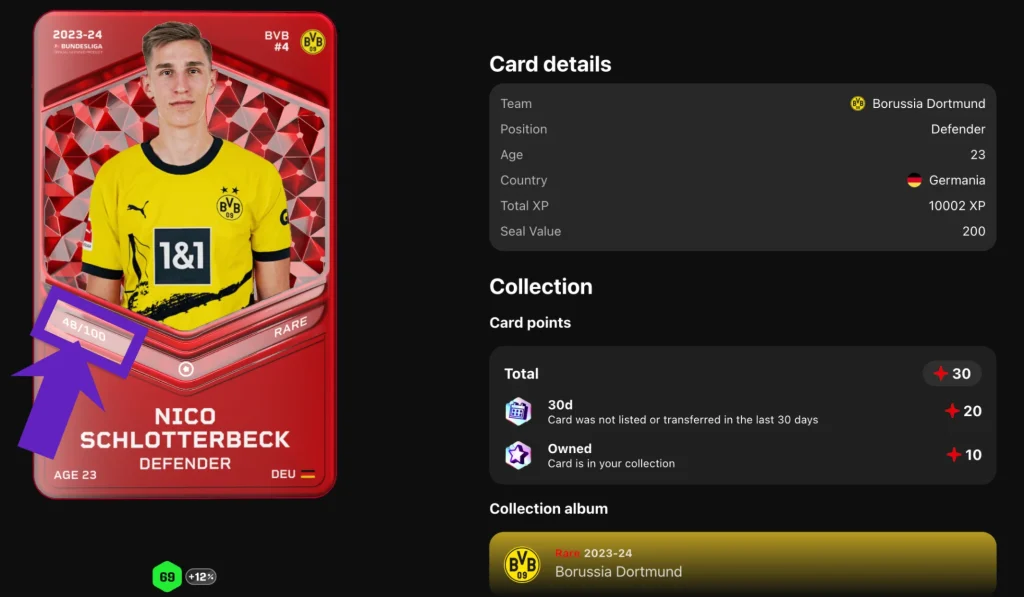
The serial number doesn’t change the real footballer’s performance or make him score more fantasy points.
However, certain numbers can matter to collectors. The first serial, the final serial, or a number matching the player’s shirt number may attract extra demand.
If I’m buying purely for lineup utility, I usually don’t want to pay much extra for a special number but I completely respect that a collector may have a completely different view 🙂
XP and card level
Cards can earn XP through gameplay. As XP accumulates, the individual card can progress through levels with 0 being the starting point and 10 the top level.
Below you can see that my Arda Güler’s Rare card (one of my favorites in my gallery by the way) is already at the maximum level of XP.
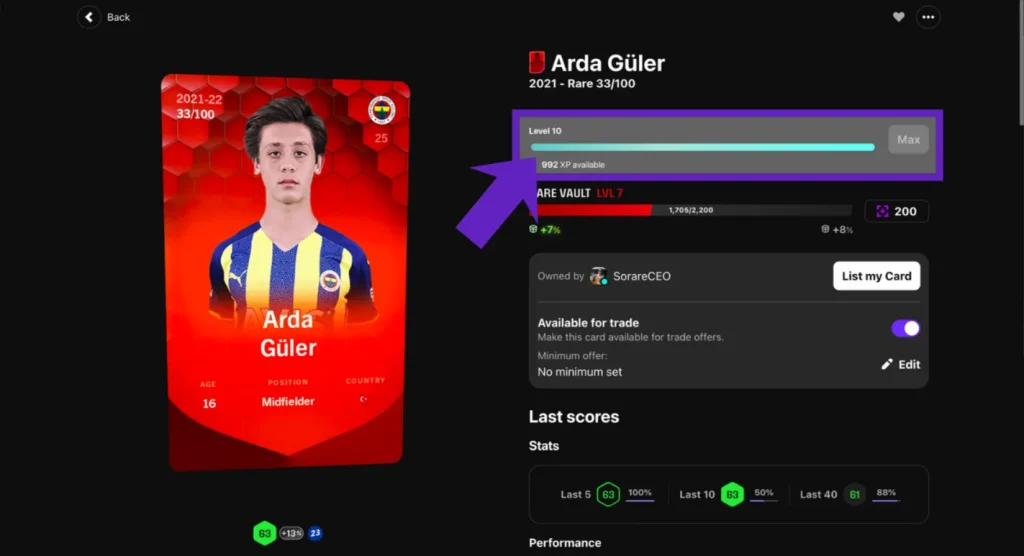
This progression belongs to that particular card. If you own two cards of the same footballer, one can have more XP and a higher level than the other.
Higher levels can provide an additional scoring bonus in eligible competitions which means that means an experienced card can have a small gameplay advantage over a fresh version of the same player.
I still put player quality and utility first. Plenty of XP won’t rescue a card belonging to someone who rarely gets onto the pitch or scores poorly.
Learn more about how this works by reading my explanation of card levels on Sorare.
Card bonuses
Bonuses can increase the score a card contributes to your lineup.
The footballer first produces his normal Sorare score from the real match. Sorare then applies any relevant card bonus when calculating what that card contributes.
Your total applicable bonus can depend on factors such as card XP level (maximum +10%), collection bonus (maximum +5%), and In Season status (fixed +5%).
For example, my Classic Nico Schlotterbeck Rare card you see below has a total bonus of 13%. He has a collection bonus of 5% + XP level of 7 which gives him extra 7% = total 12%.
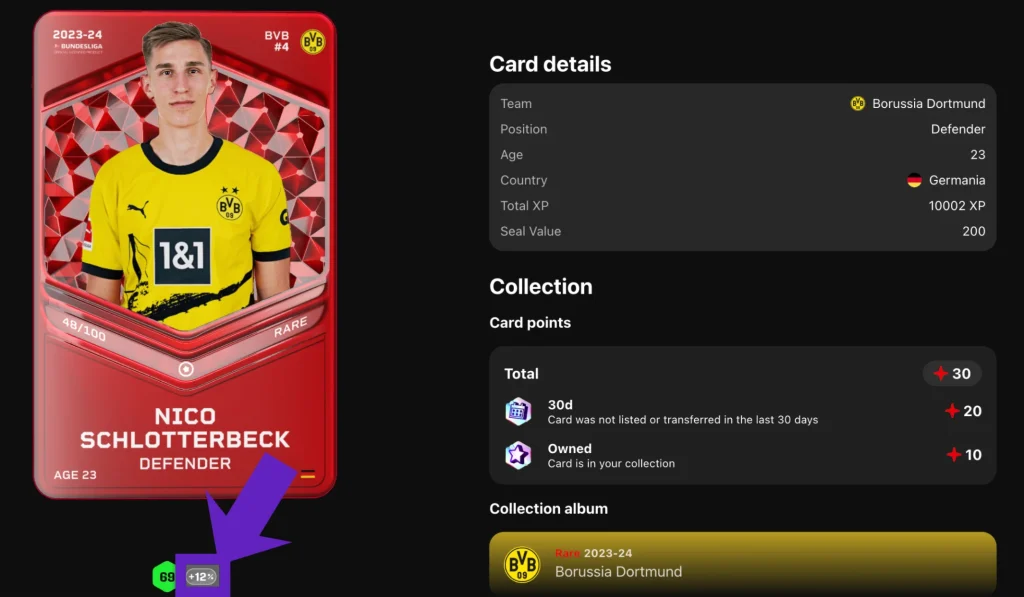
This is why two cards representing the same player can contribute slightly different final scores from the same real world performance.
Bonuses matter, especially when rankings are close. But I treat them as an extra advantage rather than the main reason to buy a player.
Player, club, and competition information
A Sorare card also identifies the player details, as well as club and competition connected with that particular issuance.
The club shown on an older card doesn’t automatically change when the footballer transfers. If he later joins another team, your existing card remains connected visually and historically with its original issuance but his performances are tracked from his new club and/or league.
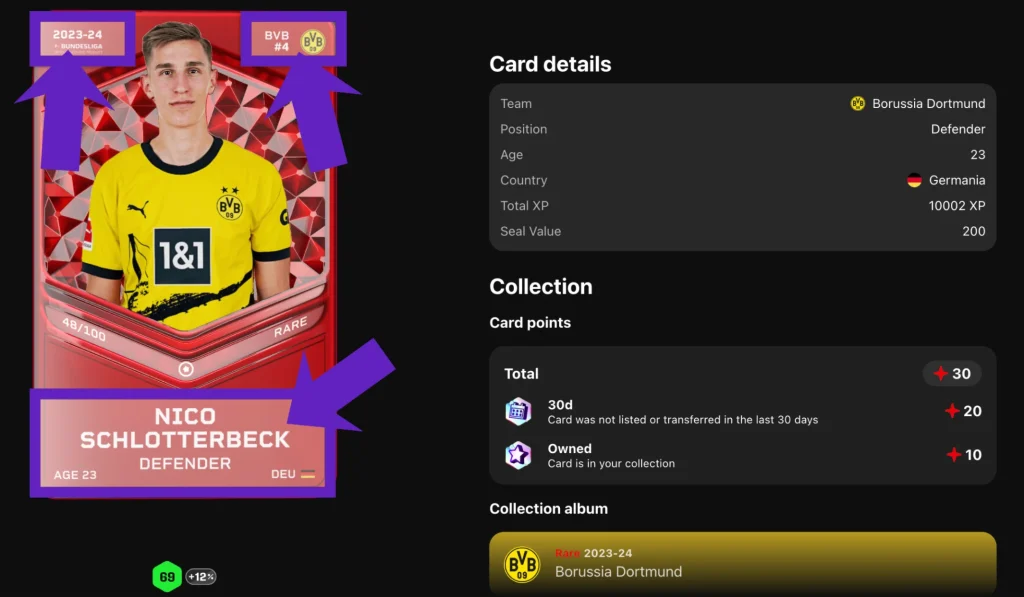
In the screenshot above, the highlighted information includes the player’s name, position on the field, age, nationality, as well as a shirt number. There’s also the club logo and the exact season the card was issued in.
Cards Utility Over Time

One of the biggest beginner questions is what happens to Sorare cards after the season ends.
- Do they expire?
- Does Sorare replace them?
- What happens if the player transfers or retires?
The simple answer is that your collectible card remains yours. What can change over time is its status, fantasy utility, and market value.
I think separating ownership from utility makes everything in this section much easier to understand.
In Season vs Classic Sorare cards
A newly issued card starts with In Season status for its relevant season. Eventually, that card becomes Classic.
Under Sorare’s current system, a card loses In Season status 11 days before the first match of the new league season for the club shown on the card.
When that happens, you don’t lose the card. It stays in your gallery with its existing XP and level, but its seasonal status changes.
The card also loses its 5% New Season Bonus. More importantly, it no longer qualifies as an In Season card for competitions that require current season cards.
Classic doesn’t mean useless, though. If an eligible competition accepts Classic cards, you can continue using it there. And that’s what I do on a weekly basis 🙂
Do Sorare cards expire?
No, Pro cards don’t expire simply because a new season begins.
You can keep an older card, sell it, trade it or continue using it wherever it remains eligible.
This is very different from saying its utility never changes.
A Classic card may lose access to In Season competitions. A player can lose his starting position. Sorare can change competition formats. Several things can make an old card less useful without making the card itself expire.
I’ve held some cards across several seasons. Whether I continue holding them depends much more on what I can still do with them than the year printed on the card.
What happens when a player transfers?
A transfer doesn’t remove or rewrite your existing card.
If your player moves from Club A to Club B, the design of the card you already own keeps the club and season from its original issuance but his scores are tracked at his new club. Sorare may later release new cards showing him at Club B but you don’t need to buy them.
For fantasy purposes, I care more about what the move does to the player:
- Will he start regularly?
- Has his role changed?
- Does the new competition have Sorare scoring coverage?
- Does the transfer improve or reduce the competitions where I can use him?
A move to a bigger club isn’t automatically good news. A reliable starter can quickly become a rotation player after taking a step up.
What if a player moves to an uncovered league or club?
This can have a much bigger effect on utility.
If Sorare doesn’t provide eligible scoring for the player’s new matches, your card may no longer generate the scores you need for fantasy competitions.
You still own it. Nothing disappears from your gallery.
But a card without scoring coverage can lose much of its practical value to managers who primarily buy cards for competitions.
This is why I check transfer situations before making purchases, especially during summer and winter transfer windows. A cheap card isn’t much of a bargain if the player moves somewhere I can’t use him a week later.
What happens when a player retires?
Retirement is probably the clearest example of ownership continuing while fantasy utility disappears.
Your card remains yours after the footballer retires. You can keep the collectible, and collector demand may still exist.
However, a retired player no longer produces new professional match performances. Without those matches, the card loses the fantasy utility it had while he was active.
Its market value can change accordingly, and there is no guarantee that someone will later pay a fraction of what you paid originally to get it.
💡 So when thinking about Sorare cards over the long term, remember one rule: the collectible can stay with you indefinitely, but its competitive usefulness isn’t guaranteed forever.
Players move, retire, lose starting positions, and enter different competitions. Sorare itself evolves too. Understanding that before buying makes it much easier to build a collection around actual utility rather than assuming every card will remain equally useful forever.
How to Get Sorare Cards

There are several ways to get Sorare cards. You can buy newly issued cards directly from Sorare, purchase cards already owned by other managers, trade, or earn cards through gameplay.
I use different methods depending on what I need. If I’m targeting one specific player and season, the secondary market usually gives me more control. If I’m looking for newly issued cards, I may check Sorare’s auctions market instead.
💡 PRO TIP: If you plan to make a purchase, make sure to use my Sorare sign-up code to enjoy your first cards for less.
Primary Market: Auctions & Instant Buys
Auctions are one way Sorare releases new collectible cards into circulation.
Managers bid against each other during a fixed auction period. When the auction closes, the highest valid bidder gets the card.
Join Sorare with code SORARECEO to get free $150 for your first cards.
SORARECEO
COPY
SorareCEO.com is a certified affiliate partner of Sorare. This is an exclusive bonus for my readers.
This means there isn’t necessarily one fixed price for a newly issued card. Demand from other managers helps determine the final amount.
Auctions can be tempting when several people start bidding on a player you want. I’ve learned not to treat winning the auction as the objective… getting the card at a price that makes sense is.
Before bidding, I check history pricing of the player and decide what I’m willing to pay. If the auction moves beyond that number, I can wait for another opportunity.
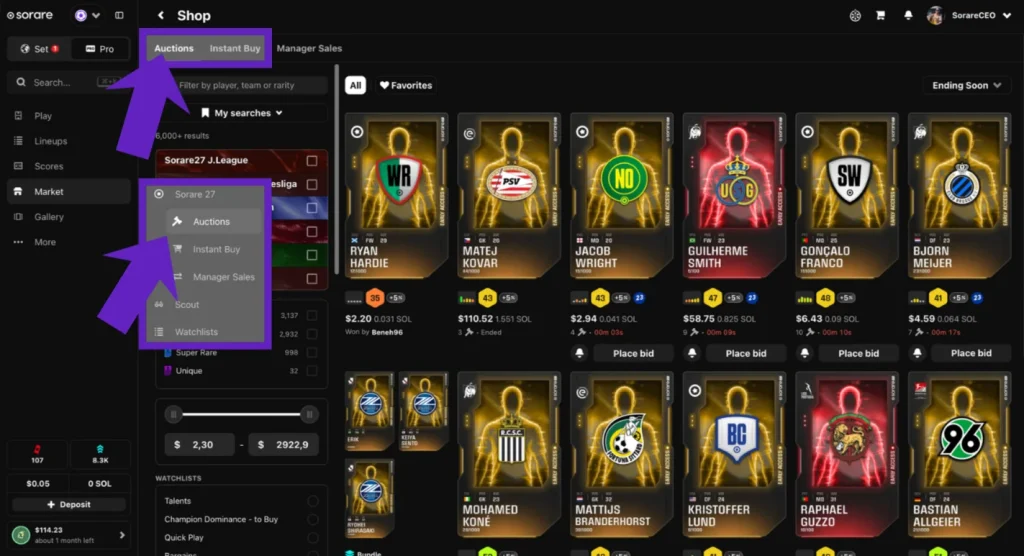
Sorare can also offer cards through Instant Buy. Instead of competing with other managers through bids, you see a price and can purchase the card immediately. That makes the process much simpler when you don’t want to wait for an auction to finish.
But normally you pay for that extra comfort since Instant Buys are roughly + 20-30% to the average auction market value.
Buying Sorare cards from other managers
The secondary market is where managers sell collectible cards they already own.
This gives you access to much more than newly issued cards. You can find different seasons, XP levels, serial numbers, and scarcities of the same player.
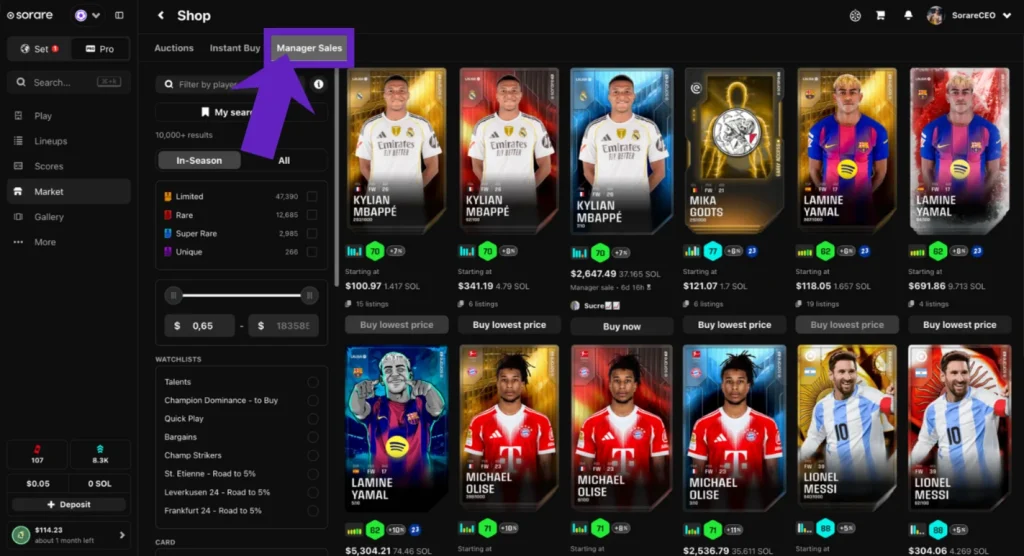
That’s particularly useful when I don’t need an In Season card. An older Classic version may provide the utility I want at a much lower price.
Manager listings also make comparison important. Two cards representing the same footballer can have different asking prices, so I rarely buy the first one I see.
Offers and trades
You can also interact directly with other managers through Sorare’s offer and trading features.
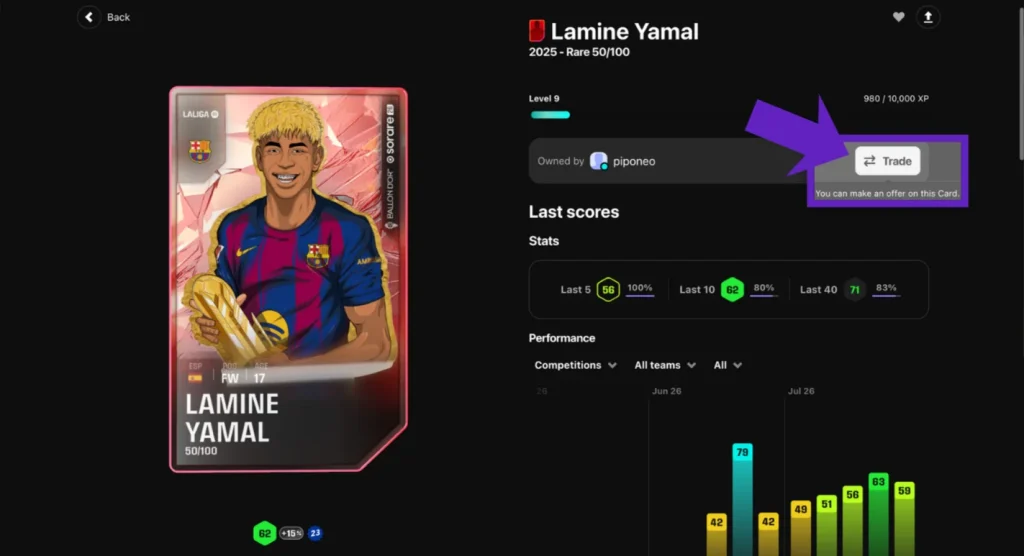
This can give you another route to a card when the listed price doesn’t work for you. Depending on the available trading options, deals can involve cards, funds, or a combination of both.
Just make sure you’re comparing the entire deal rather than counting cards. Receiving three cards for one doesn’t mean you’ve won the trade if those three cards have less value or utility for your club.
Rewards
Buying isn’t the only way to add cards to your gallery. You can also earn Sorare cards through gameplay! And that’s my main way of adding to my gallery 🙂
The exact rewards differ across different game modes and can change as the platform evolves but in general the Pro mode provide cards or resources through progression and competition rewards.
For me, earning a useful player always feels better than buying one. That card becomes part of the story of my club rather than another marketplace purchase.
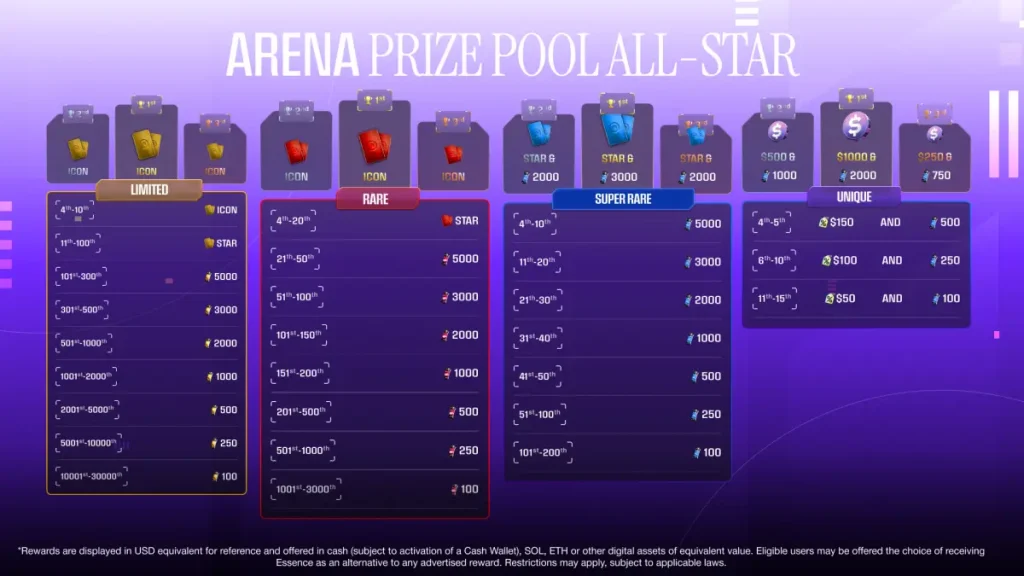
Below you can find an exemplary prize pool of one of Sorare Classic competitions, the All-Star. As you can see, only a small portion of leaderboard places reward cards, but lower standings do reward Essence with which you can craft your own cards (more about this below).
Card Factory
The last method of acquiring Sorare cards is through the process called Crafting.
You can craft the cards in the Card Factory using the Essence you won by finishing high enough on the leaderboards of selected competitions.
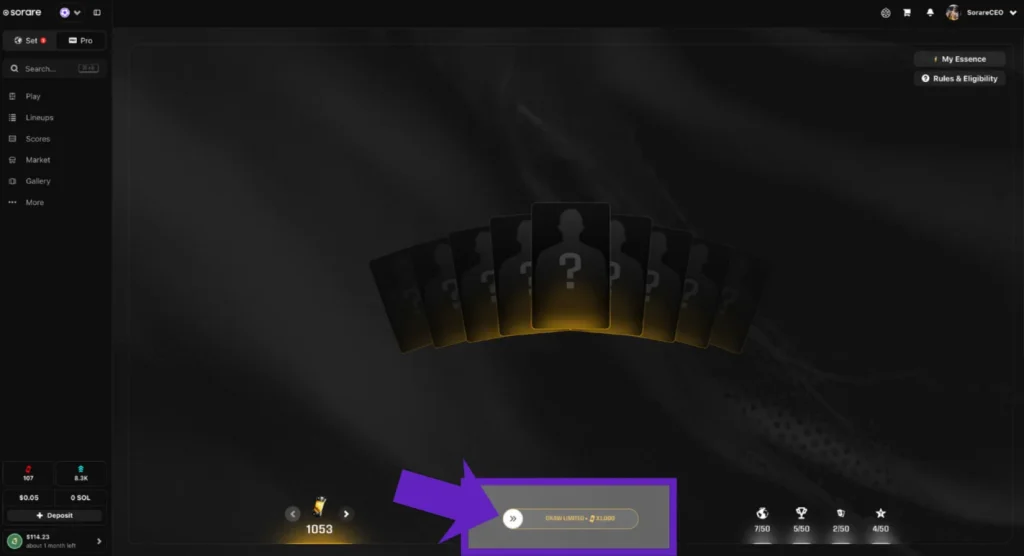
The number of Essence required to craft a card is 1,000, but to increase the chances of crafting a quality player, it will cost you more to use some of the crafting clues such as the player’s nationality or the league he plays in.
How Sorare Card Prices and Value Work

There is no fixed price for Sorare cards. Two cards of the same player can have different prices, while the value of either card can change as football and the market change.
This is why I don’t ask only, “How much does this player cost?” I look at the exact card, what I can do with it, and what comparable cards are actually selling for.
Remember that a market listing is also just an asking price. Someone listing a card for $500 doesn’t automatically make it worth $500. A completed sale tells you much more about what another manager was prepared to pay.
Player quality and performance
The footballer behind the card is an obvious starting point. Players who start regularly and produce useful Sorare scores usually have more fantasy utility – and therefore their prices increase.
But real world reputation and Sorare value don’t always match.
A famous attacker can be frustrating if he misses big chances frequently or is prone to rotation. Meanwhile, a less popular midfielder who starts every match and scores consistently may be much more useful to my lineups.
That’s why I look beyond goals and big names. Minutes, role, scoring profile, injuries, and competition for a starting place all matter.
Scarcity and available supply
Scarcity limits how many cards Sorare can issue within each tier. Fewer cards generally means fewer opportunities for managers to own that version of a player.
Actual market supply matters too.
There might be 100 Rare cards from an issuance, but perhaps only two owners currently want to sell. Another player could have fewer cards overall but many listings competing for buyers.
Competition utility
This is one of the biggest factors for me.
Cards have value to fantasy managers because they can help build eligible lineups. If a player or card fits competitions with strong demand, more managers may want access to that utility.
The opposite can happen when utility falls. A good footballer isn’t much help if his card doesn’t fit the competition you’re trying to enter.
Sorare can also change competition formats and eligibility rules over time. That means card demand can move even when nothing changes with the footballer himself.
In Season and Classic status
Seasonal status can create a noticeable difference between two cards of the same player.
An In Season card can provide access to competitions requiring current season cards that offer much better rewards, while a Classic version cannot provide that same seasonal utility.
That doesn’t automatically make In Season the better purchase.
If I’m building for Classic competitions, an older card may give me exactly what I need without paying for In Season utility I won’t use.
This is another reason I think about what I want to play before deciding which Sorare cards to buy.
Serial numbers
Serial numbers can affect collector demand, especially when a number has some connection with the player.
Card number “one” can attract interest. So can the final serial or a number matching the player’s shirt number.
For fantasy purposes, that number doesn’t improve the player’s score. If two otherwise identical cards have different serials, the footballer still produces the same underlying match performance.
I rarely pay a large serial premium when I’m buying for gameplay. If collecting is your priority, you may value those details much more than I do.
Transfers and future expectations
Sorare markets don’t only react to what a player is doing today. Managers also price in what they think will happen next.
A young backup goalkeeper linked with a move where he could become a starter may attract more demand before the transfer even happens. The same applies to prospects expected to receive more minutes.
Those expectations can be wrong.
A transfer might produce less playing time instead of more. A promising youngster might spend another season on the bench. A player could move outside useful Sorare scoring coverage.
I’ve learned to be careful about paying today for a future situation that hasn’t happened yet. You’re buying the player you actually get, not the version everyone hopes he’ll become.
Collector demand
Not everyone buys Sorare cards purely to maximize fantasy scores.
Some managers collect particular clubs, players, seasons, serial numbers, or special editions. That creates demand that has little to do with whether the card gives someone the best possible lineup.
A special card of a popular footballer can therefore command a premium even when a cheaper version provides similar fantasy utility.
Neither approach is wrong. You just need to know which market you’re participating in.
If I’m buying for competition use, I care most about minutes, scoring, eligibility, and price. If I’m buying something because I genuinely want that particular collectible, I’m comfortable judging it differently.
💡 Note down that a Sorare card is worth what another manager is willing to pay for it at that moment. Player performance, scarcity, utility, season, future expectations, and collector demand all influence that number. And none of them guarantees what the card will be worth later. I treat card prices as moving market values, not promises of future returns.
Ways to Utilize Cards

Sorare cards connect several parts of the platform. You can use them competitively, build collections around them, trade them with other managers, and keep collectible cards across multiple seasons.
What you actually do with a card depends on why you acquired it. Most of mine have a solely fantasy purpose, but that doesn’t need to be the only reason for owning one.
Enter competitions to win rewards
The main use for my cards is entering fantasy competitions. I think it’s fair to say that it’s the same for 99% of other managers on the platform.
You build a lineup from eligible cards, submit it to a competition, and then follow the real matches. Your players’ performances determine how that lineup scores and what rewards you win.
Competition rules decide which cards qualify. Season, scarcity, position, and other requirements can therefore affect where you can use a particular card.
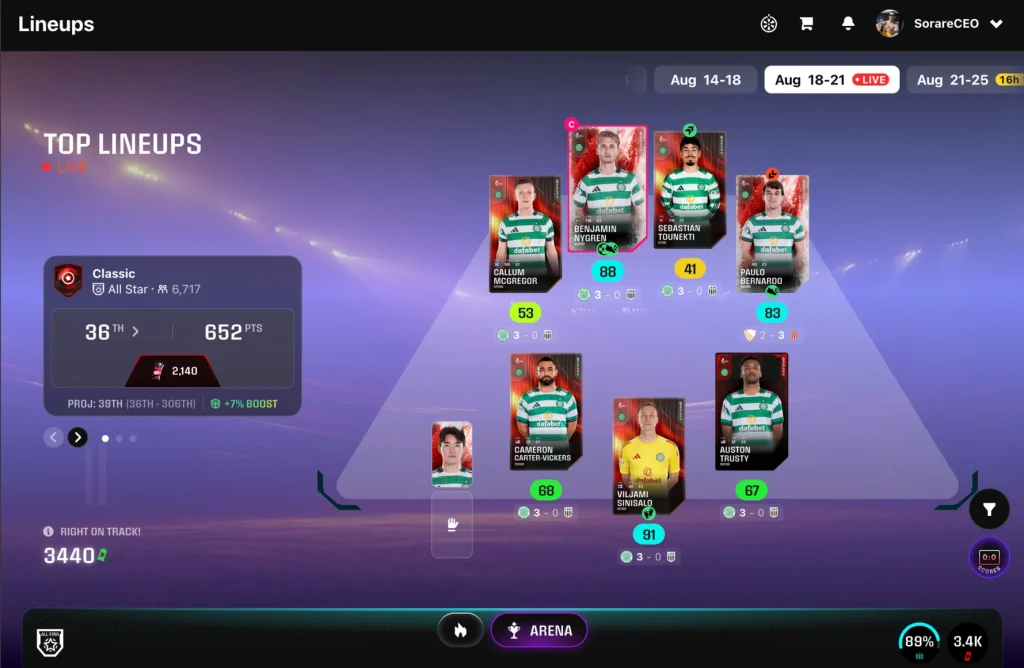
This is why I think about utility before buying. A great player isn’t particularly helpful if his card doesn’t fit the lineup I’m trying to build.
As your gallery grows, you can start building lineups for different competitions rather than relying on one group of players.
You might have one lineup built around In Season cards and another using Classic cards. You can also create depth for injuries, rotation, difficult fixtures, or overlapping Game Weeks.
More cards give you options, but quantity alone isn’t the goal. I’d rather own 30 Sorare cards that regularly compete for places in my lineups than 100 cards I barely use. A large gallery can still be a poorly constructed gallery.
The exact reward you can win with your lineup depends on the competition and game mode. Depending on the format, rewards can include cards, cash, or resources used elsewhere within the game, such as Essence.
💡 Pro tip: if you want to maximize your chances of early success, make sure to read my guide on how to play Sorare.
A card can therefore contribute repeatedly rather than having one single use. You might play the same reliable midfielder across many Game Weeks and earn several rewards with lineups containing him.
That’s one reason consistent utility matters so much to me on Sorare.
Collect players and clubs
Sorare also works as a collecting platform.
You can collect cards from a favorite club, follow one player across different seasons, target certain scarcities, or look for particular editions and serial numbers.
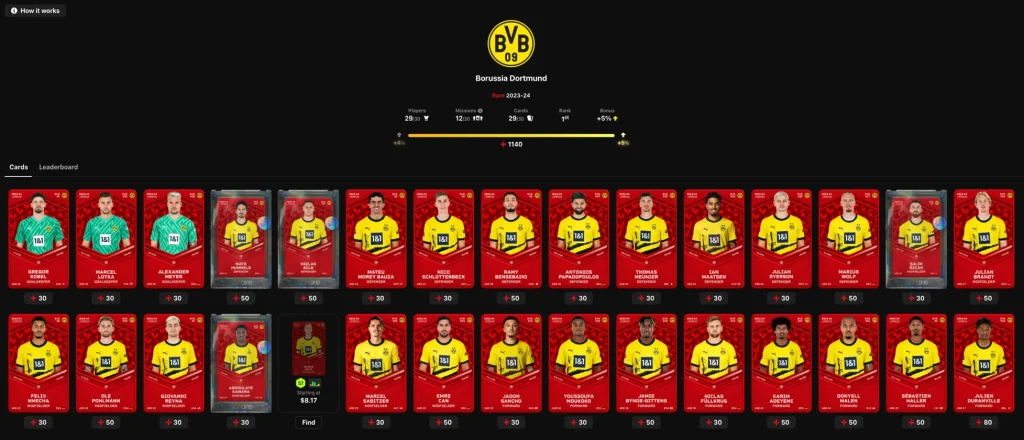
Sorare’s Collection Game gives the collecting side additional structure by letting eligible cards contribute toward club collections.
I mostly think about fantasy utility, but I understand the appeal of owning cards simply because you want them. Sometimes being a football fan wins over perfect squad efficiency.
Buy, sell, and trade cards
Pro cards can move between managers.
If you no longer need a player, you can list an eligible card for sale or consider offers from other managers. You can also use Sorare’s trading features to reshape your gallery.
This becomes useful as your strategy changes.
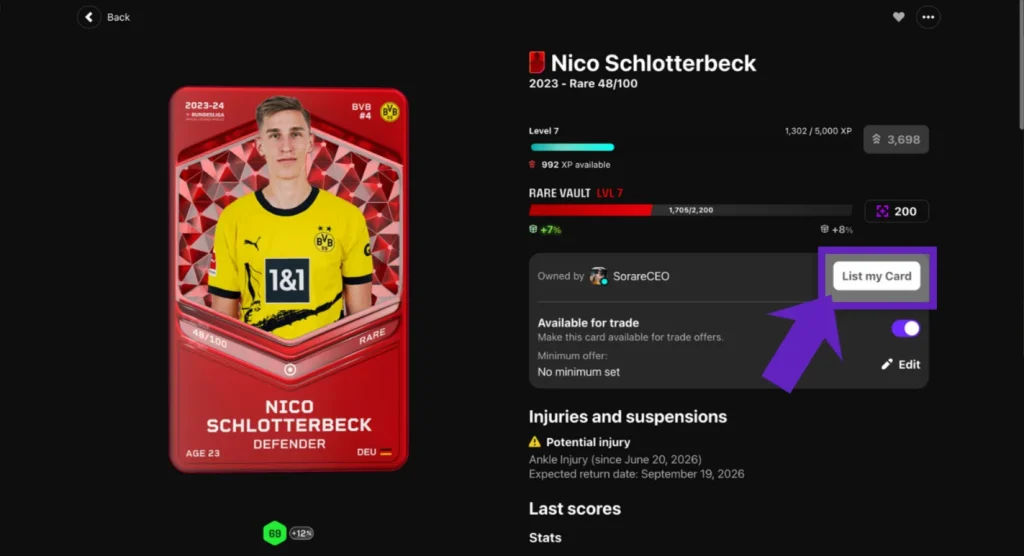
You can easily list on the market any card in your gallery, as highlighted in the screenshot below.
I’ve sold cards that were perfectly good scorers simply because I stopped using them (since I could afford better ones). Keeping a useful card on the bench forever doesn’t help much when its value could strengthen another position.
Of course, selling for more than you paid isn’t guaranteed. Card prices can rise or fall while you own them.
Keep cards across seasons
You don’t have to sell a collectible card when the football season finishes.
You can keep it in your gallery as it moves from In Season to Classic status and continue using it wherever it remains eligible.
You might also hold a card because you expect the player’s situation to improve, because it belongs to a collection, or simply because you like owning it.
There isn’t one correct holding period. I’ve kept some Sorare cards for years and moved others fairly quickly.
The question I find more useful is: what job does this card have in my club? If I can answer that, I usually have a reason to keep it. If I can’t, I start wondering whether those funds could be doing something more useful elsewhere.
Which Sorare Cards Should You Buy?

There isn’t one list of cards that every manager should buy. The right cards depend on your desired competitions, budget, strategy, and how seriously you want to build your gallery.
If you’re new, I would avoid opening the market and simply looking for famous players you can’t afford. Start with what you want to play, then work backward.
That’s the approach I wish I had followed more consistently when I joined in 2022.
Start with the competition you want to play
Before buying your first card, decide where you actually want to use it.
💡 Pro tip: for people dipping their toes into Sorare, I always recommend starting out with a league you actually follow and have some knowledge about. This is super important because it really improves your chances of success when coming up against less knowledgeable managers.
Do you follow La Liga? See if you can afford cards for that league.
Are you more of a fan of the Bundesliga? Do the same thing.
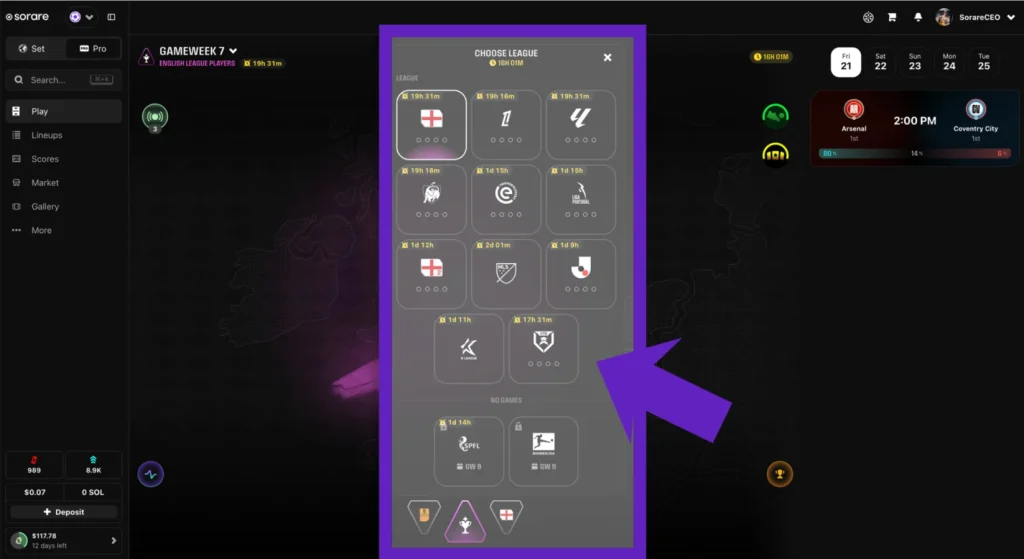
The same works for any of the other available competitions on Sorare, whether talking about the big European leagues or smaller equivalents on other continents.
Check the competition requirements and work out which positions and card types you need. This immediately gives your purchases some structure.
For example, building toward an In Season competition obviously changes your shopping list compared with building a Classic lineup.
I like planning the entire lineup before buying the first player. Otherwise, it’s easy to find four cheap cards and later discover that the final position destroys your budget (goalkeepers have taught plenty of Sorare managers that lesson over the years 🙂 ).
Choose the right scarcity
Don’t automatically assume you should buy the highest scarcity you can afford.
Limited, Rare, Super Rare, and Unique cards serve different purposes within Sorare. The correct choice depends on the competitions you want to enter and the amount you’re comfortable spending.
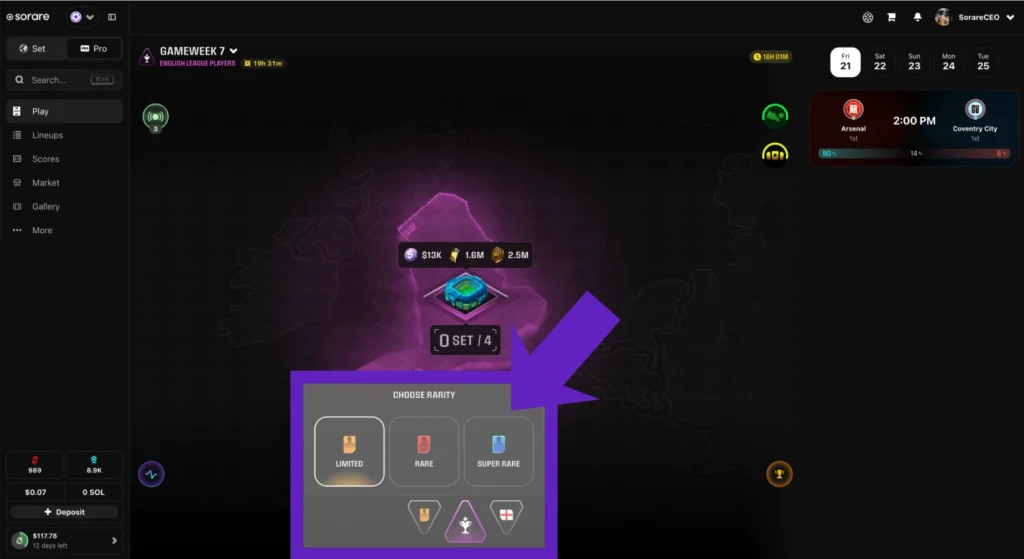
If Limited cards give you access to the gameplay you want, moving into Rare purely because Rare sounds more exclusive doesn’t accomplish much.
I prefer deciding on the competition first. That normally tells me which scarcity actually makes sense.
You can always move into another scarcity later once you understand why you want to.
Decide between In Season and Classic cards
This choice can have a major effect on both utility and budget.
If your target competition requires In Season cards, the decision is straightforward. You need the relevant current season cards.
If you’re building for Classic competitions, older Sorare cards may provide the utility you need without paying for current season status.
I don’t pay extra for In Season simply because newer feels better. I want the additional utility to have a purpose in my club.
Remember that today’s In Season card will eventually become Classic too. Think beyond the current Game Week when comparing prices.
Focus on player utility
This is probably the most important part of my buying process.
I want players who actually play.
Before buying, I check recent minutes, injuries, suspensions, rotation risk, competition for the position, and any serious transfer situation. Then I look at the player’s Sorare scoring profile.
A player who produces reliable scores without depending entirely on goals or assists can be particularly useful across a season.
I also think about how often I can realistically use him. A good player with awkward eligibility or constant rotation may provide less value to my gallery than a less famous regular starter.
Young prospects require extra caution. Potential can be exciting, but you’re paying real money for what the player offers now plus whatever future development the market already expects.
Not every promising 19 year old becomes the player everyone imagined.
Set a budget before you start buying
Sorare doesn’t require a huge budget to start collecting, but having a clear limit helps.
I would set a budget for a complete lineup rather than deciding how much to spend on each card separately.
Then distribute that money according to the positions you need.
Join Sorare with code SORARECEO to get free $150 for your first cards.
SORARECEO
COPY
SorareCEO.com is a certified affiliate partner of Sorare. This is an exclusive bonus for my readers.
Don’t spend 70% of your budget on one star and leave yourself searching for four barely playable cards unless that’s genuinely your strategy.
I also wouldn’t spend your entire available budget on the minimum number of starters.
Footballers get injured, rotated, suspended, and transferred. Once you’ve established your main lineup, some useful depth can make the gallery much easier to manage.
Build that depth gradually, though. You don’t need 50 cards during your first week.
My approach to building a Sorare gallery
My gallery is obviously much larger now than when I started in 2022, but my buying process has become simpler rather than more complicated.
I build around needs, not cards.
If one of my regular lineups has a weak position, I look for a player who improves it. If I want to enter another competition, I identify everything that lineup requires before buying anything.
I also prefer a smaller number of useful cards over filling my gallery with bargains that never play.
Cheap doesn’t mean good value. A $3 card you never use has given your club less than a $20 card you play every week.
From time to time, I go through my collection and ask myself why I still own certain players.
If a card regularly enters my lineups, provides useful depth, belongs to a collection I care about, or fits a future plan, it has a purpose.
If I haven’t used it for months and can’t see that changing, I consider selling it and moving those funds somewhere more useful.
I don’t always get these decisions right. I’ve sold players shortly before their situation improved and held others far longer than I should have. Football makes sure nobody gets every decision right.
If you’re starting your first gallery, you don’t need the rarest cards or the biggest names. You need players who fit your competitions, your budget, and the way you actually want to play Sorare.
For more information on the current state of the game, have a look at my review of Sorare.





2 thoughts on “Understanding Sorare Cards in 2026 [The Ultimate Guide]”