


Sorare card scarcities are one of the first things you’ll notice when you start exploring cards on the platform. Limited cards are yellow, Rare are red, Super Rare are blue, and Unique are purple (they were previously black). Then you also have grey Common cards for free gameplay.
At first, the system looks like a simple rarity ladder. Fewer cards exist as you move upward, so you might assume that scarcer automatically means better. It doesn’t.
Scarcity affects supply, card bonuses, competition access, market prices, and how you can build your Sorare club. But it doesn’t make the real footballer behind the card perform any better.
In this guide, I’ll explain every Sorare scarcity from Common through Unique. We’ll compare supply, colors, serial numbers, bonuses, competition utility, and typical price differences.
More importantly, we’ll look at how those differences affect actual gameplay and which scarcity makes sense for different types of managers (including you).

Join Sorare with code SORARECEO to get free $150 for your first cards.
SORARECEO
COPY
SorareCEO.com is a certified affiliate partner of Sorare. This is an exclusive bonus for my readers.
The Definition of Card Scarcities

In the simplest terms possible, card scarcities are different supply tiers for player cards. In other words, each scarcity limits how many cards of a player Sorare can issue within a season and helps determine how that card fits into the game.
In Sorare Football (which I exclusively focus on), the scarcity levels are the following:
- Common
- Limited
- Rare
- Super Rare
- Unique
As you move through those tiers, the available supply becomes smaller. Scarcity is therefore about much more than the color around a player card.
Why does Sorare use different scarcity levels?
If Sorare issued unlimited cards of every player, owning one wouldn’t mean much from a supply (or collecting) perspective.
Scarcity creates fixed differences in how many cards can enter circulation every season. Limited cards have much more potential supply than Rare cards, while only one Unique card of a player can be issued within a standard seasonal issuance.
This gives Sorare several ways of collecting and competition. And most importantly, it’s good news for people new on the platform, because it means that a you can start with more accessible card types rather than needing the rarest (and most expensive) cards immediately.
Looking back to when I was starting out, I’m glad that Limited cards were indeed my first purchases on Sorare because sure enough I made a lot of early mistakes (and doing them with Rares would have been a few times more costly).
What does card scarcity actually change?
Supply is the most obvious difference, but it isn’t the only one.
Your card’s scarcity can affect its base bonus structure and the competitions where you can use it. It can also have a major effect on price because fewer copies are available at higher tiers.

Scarcity also changes the type of gallery you’re building. Putting together a Limited squad is very different from building around Super Rare cards. The player research may be similar, but card availability, required budget, and competition options can change considerably.
That’s why you shouldn’t treat moving from Limited to Rare as simply changing the color of your cards. You should first decide whether it makes sense from a gameplay perspective and whether you have the right budget for it.
In other words: moving up a scarcity makes sense only if you can afford equally good players in the next scarcity. If going up means replacing your star Limited cards with bang average Rares, it makes very little sense.
Scarcity vs player quality
This distinction is probably the most important one for people trying to understand Sorare in the beginning.
A higher scarcity Sorare card scarcity does not mean a better-scoring footballer.
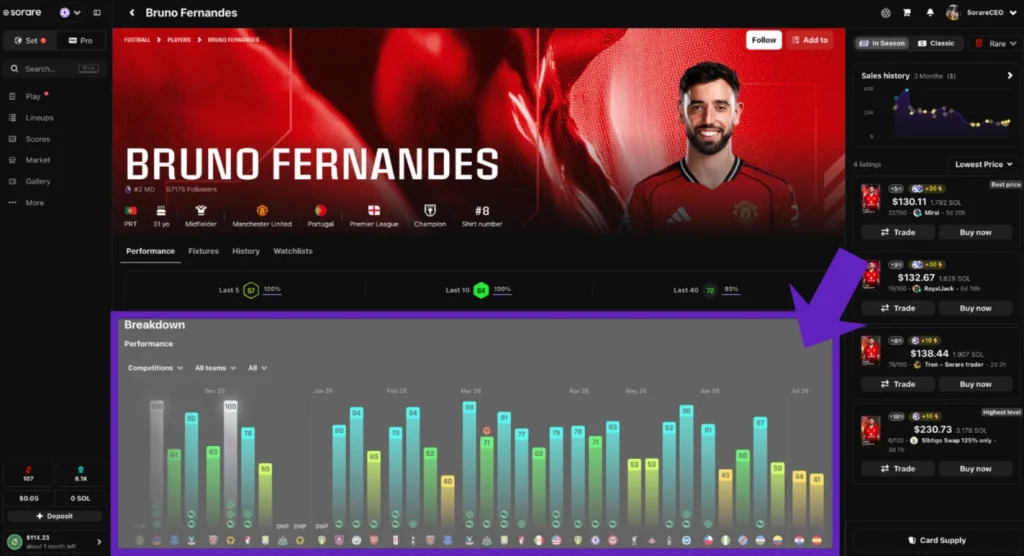
Imagine one player has a Limited, Rare, Super Rare, and Unique card from the same season. Every one of those cards represents the same person playing the same real match.
If he has a terrible Saturday afternoon, his Unique card doesn’t magically turn that performance into a great one because only one copy exists.
Likewise, a strong Limited player can be far more useful than a poor Rare player.
Bonuses and competition rules can create differences in how cards contribute to the gameplay, which we’ll cover later. But the footballer’s underlying performance comes from what actually happens on the pitch.
A Closer Look at All 5 Scarcities

As already touched upon in the section above, Sorare offers 5 different scarcities in the form of Common, Limited, Rare, Super Rare, and Unique. You already know that each has its own color, supply, market status, and role within the game.
The biggest jump is between Common and Limited, because Common cards belong to Sorare’s free gameplay system called Arcade Sets, while Limited through Unique are collectible cards which ownership is verifiable and – most importantly – you can sell them to other people on the platform.

Common Cards
Common cards are grey and provide an entry point into Sorare without requiring you to buy collectible cards.
Unlike the four collectible scarcities, Common cards aren’t tradable assets you can sell to another manager. Their main purpose is gameplay and learning about the mechanics of the game risk-free.

That makes Common useful when you’re a beginner learning Sorare. You can understand players, scoring, lineup building, and Game Weeks before deciding whether you want to spend any money.
Limited Cards
Limited cards are yellow and form the first collectible scarcity tier. Sorare can issue up to 1,000 Limited cards of a player during a standard seasonal issuance.
That larger supply makes Limited much more widely available than the higher collectible tiers.

For many managers, this is the natural starting point for building a paid gallery. You can buy and sell Limited cards, use them where competition rules allow, and build around the same football research required at higher scarcities.
Limited doesn’t mean every card is inexpensive. A top player can still command a substantial price, often a lot bigger than an average player in higher scarcity levels.
Rare Cards
Rare cards are red, with up to 100 cards of a player available within a standard seasonal issuance.
That means the maximum supply is only one tenth of the Limited tier.

Rare also opens another level of Sorare competition and card bonuses. This is why I don’t view Rare as simply a more exclusive collectible.
If I move from Limited into Rare, I want a gameplay reason for doing it that will benefit my strategy. Paying more just to own a red version of the same footballer isn’t much of a strategy 🙂
Super Rare Cards
Super Rare cards are blue, and the seasonal supply falls to a maximum of 10 cards per player.
At this point, finding the exact player you want can become much harder. Even if all 10 cards have been issued, their owners may have no interest in selling them.

This lower supply can also create a very different market. One listing or sale can matter much more when there are only a handful of comparable cards available.
Super Rare cards have their own gameplay role too. If you’re considering this tier, you should already have a clear understanding of the competitions and lineup structures you’re targeting.
Unique Cards
Unique is the rarest standard Sorare card scarcity. Unique cards are now purple after previous black designs, and only one can be issued for a player within a standard seasonal issuance.
So if you own that player’s Unique card for the season, nobody else can own another Unique from the same issuance.
That one of one supply makes the Unique market very different from Limited or even Rare. There is simply no comparable current season card available when you want to buy one.

Unique cards can appeal to high budget competitive managers and collectors who specifically value one of one cards. They aren’t something you need to own to enjoy Sorare or build a competitive club at lower scarcities.
The supply ladder is therefore easy to remember: up to 1,000 Limited, 100 Rare, 10 Super Rare, and one Unique per player within a standard seasonal issuance.
Those numbers explain rarity, but they don’t tell you everything about how the cards compare. Competition access, bonuses, serial numbers, and market prices add another layer… so that’s what we’ll look at next.
Sorare Card Scarcities Compared

The easiest way to understand card scarcities is to put them next to each other. Supply drops sharply from Limited through Unique, but gameplay differences don’t follow such a simple ladder.
Here’s the quick comparison before we look at what those differences mean in practice.
| Scarcity | Seasonal Supply | Tradable | Scarcity Bonus | Role |
|---|---|---|---|---|
| Common | ∞ | No | 0% | Free gameplay |
| 🟨 Limited | Up to 1,000 | Yes | 0% | Entry-level Pro competitions |
| 🟥 Rare | Up to 100 | Yes | 10% | Mid-tier competition & higher rewards |
| 🟦 Super Rare | Up to 10 | Yes | 40% | High-stakes gameplay |
| 🟪 Unique | 1 | Yes | 40% | One of one collectible |
Scarcity serial numbers
Collectible cards also receive serial numbers within their issuance. A Rare card might therefore appear as 23/100, while a Super Rare could be 4/10.
The serial identifies the individual Sorare card. It doesn’t create another official Sorare card scarcity inside the tier. In other words, a 1/100 Rare isn’t technically scarcer than a 57/100 Rare from the same issuance. Both belong to the same Rare supply.
As an example, in the screenshot below you can see that the serial number of my Nino Schlotterbeck Rare card is 48 out of 100.
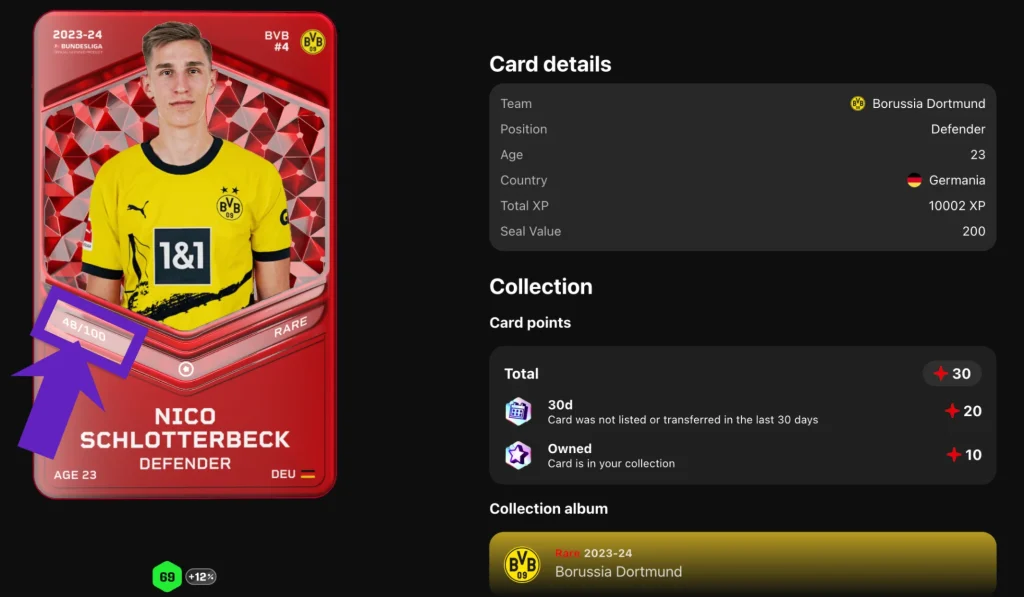
Collectors may still pay more for certain numbers, particularly the first serial, final serial, or a number matching the player’s shirt number.
Competition access
This is where scarcity starts becoming much more relevant to actual Sorare gameplay.
Different competitions require or allow different card scarcities. That means choosing Limited, Rare, Super Rare, or Unique can determine which competitive paths are available to your club.
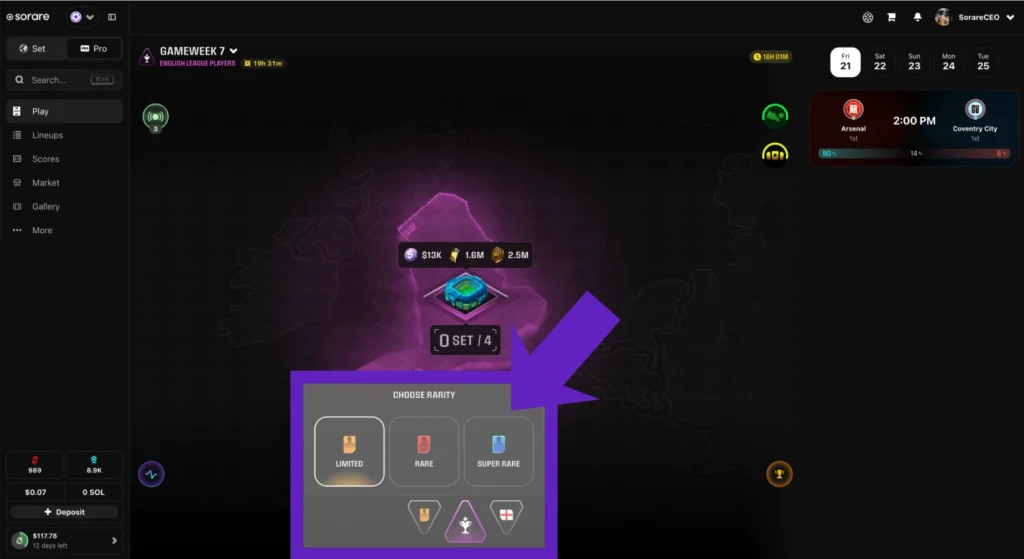
The most important rule to remember is the following: you can play your cards in competitions designed for scarcities below, but you can’t use them in competitions requiring higher scarcities.
💡 Example: let’s assume you have a gallery full of Rare cards. After submitting the maximum level of lineups in Rare competitions – instead of letting the remaining cards stand still in your gallery – you can use them to create lineups in the Limited scarcity. But you wouldn’t be able to use Limited cards to create teams in Rare competitions.
Lastly, it’s also possible to play a mix of scarcities in a single lineup. But here again please remember that you can only mix scarcities if the higher scarcity is going into one of the lower scarcities, not the other way round.
Scarcity bonuses
Scarcity can also affect the bonus attached to a card.
And now that you have read that it’s possible to enter lineups with more rare cards in the scarcities below, you might be wondering: is that even fair? Won’t that mean that people in the lower scarcity are at a disadvantage?
Luckily, the answer is a resounding NO 🙂
Even though each rarity has its own bonus, this bonus applies only to competitions within the same scarcity level.
💡 Example: let’s assume you’re a manager focusing strictly on Super Rare competitions. After submitting maximum number of lineups in your scarcity, you’re now left with some cards you’d like to use in Rare or Limited competitions. In this case, the 40% scarcity bonus applying to Super Rare cards would get leveled down to whatever scarcity you want to play in. If you want to play your cards in a Limited competition, your scarcity bonus would become 0%; in case of Rare, it would be 10%.
Typical differences in market value
Higher Sorare card scarcities have lower supply, which can make them more expensive than lower scarcity versions of the same player.
In simplest terms possible, you normally pay a premium to compete against smaller number of people 🙂
But don’t turn that into a rule that Rare must always cost more than Limited, or Unique must always be the most valuable card you can find.
Different players, seasons, competition utility, card bonuses, serial numbers, and market demand all affect price.
A Limited card of an elite starter can easily be worth more than a Rare card of a player nobody particularly wants.
This is why I compare scarcity within context. Scarcity tells you how limited the card supply is. It doesn’t tell you whether the player is good, whether the card fits your club, or exactly what somebody should pay for it.
Which Scarcity Should You Choose

There is no single best scarcity for every manager. Your choice should depend on what you want to play, how much you want to spend, and how comfortable you are building a larger collection of cards.
If you’re new, I wouldn’t start by asking which scarcity has the biggest rewards or the rarest cards. Start with the level that lets you learn Sorare without putting unnecessary pressure on your budget.
Common cards for getting started
If you’ve never played Sorare before, Common cards give you the easiest starting point.
You can learn lineup building, scoring, player selection, and Game Weeks without buying collectible cards. That experience is useful before you start deciding where to spend money.
I wouldn’t rush through this stage just because collectible cards look more interesting.
Understanding why a midfielder scores well on Sorare is more valuable than owning his Limited card without knowing what makes him useful.
Once you understand the game and want to explore collectible competitions, you can decide which paid scarcity fits your plans.
Limited vs Rare
For many managers, the first serious choice will be between Limited and Rare cards. At this point, we can call them the “core” Sorare scarcities. This is because they offer the biggest number of ways and competitions we can play.
💡 Pro tip: if you plan to buy your first cards, make sure to take advantage of my Sorare promo code which will give you a nice bonus to kickstart your journey!
For me, deciding whether to play Limited or Rare depends on what kind of a gameplay I’m looking for in that specific season:
- if I want to play the Hot Streaks mode in which you progress by reaching point targets set by Sorare, I will definitely pick Limited cards because in order to be competitive, you need A LOT of them (and buying Rare equivalents would cost a fortune)
- if I want to play the Arena mode, I’ll most likely focus on Rare cards because I want to compete against smaller number of people on the weekly leaderboards
Limited has much greater supply, which usually gives you more players and price points to choose from. That can make building complete lineups easier on a smaller budget.
Rare reduces the maximum seasonal supply from 1,000 to 100 cards per player. It also moves you into different competition opportunities and a different part of the market.
I wouldn’t choose Rare simply because it feels like the more advanced version of Sorare. Compare what your budget can actually build.
If the same amount gives you a strong Limited lineup or a weak Rare lineup filled with questionable starters, Limited may give you a much better experience.
On the other hand, if you already understand Sorare and specifically want a more exclusive ways to play available with Rare cards, moving up can make sense.
When does Super Rare start making sense?
Super Rare is where I think you need to become much more deliberate.
With only up to 10 cards per player in a standard seasonal issuance, availability becomes a real part of squad building. You can’t assume the exact player you want will always be sitting on the market.
The budget can increase considerably too.
Before moving into Super Rare, I’d want to understand the relevant competitions, expected costs, available player pool, and how much flexibility my gallery will have.
You should also be comfortable with lower liquidity. Selling a Limited card with many potential buyers can be very different from finding the right buyer for a much scarcer card.
Super Rare can make sense when you have enough budget to build properly around it and you’ve plenty of experience playing the game already. Buying one random Super Rare because it looks cheap isn’t much of a strategy.
I definitely wouldn’t recommend jumping straight into Super Rare for new users.
Who are Unique cards really for?
Unique cards sit in another category entirely, although since Sorare 26 they share the same competitions as Super Rares. The incentive to buy Uniques over Supers is that your rewards from the leaderboards are boosted by Sorare.
Only one standard seasonal Unique exists for each player, which makes availability extremely limited. If the owner doesn’t want to sell, you can’t simply find another identical copy.
That makes Unique relevant mainly to managers with larger budgets, collectors who value one of one cards, and experienced players deliberately targeting gameplay involving this scarcity.
You absolutely don’t need Unique cards to experience the important parts of Sorare.
I wouldn’t recommend that a beginner looks at Unique as some final card level they eventually need to reach either. Sorare isn’t a game where progressing means moving from yellow to red to blue and finally purple.
Each scarcity represents a different way of building and competing.
My approach to choosing a Sorare scarcity
Since joining in 2022, I’ve become much less interested in scarcity for scarcity’s sake.
I work kind of backward from the competition.
First, I decide what I want to play. Then I check the card requirements, estimate what a competitive lineup would realistically cost, and look at the players available within that budget. Only then do I decide whether that scarcity makes sense for me.
I also prefer having enough budget for a functional group of cards rather than spending everything on average players that are not going to bring me any joy (and success).
Five good cards can get you started in the right format, but football doesn’t cooperate forever. Injuries, rotation, transfers, and bad fixtures eventually make depth useful.
This is especially important as you move into more expensive scarcities. Owning one impressive card and four players you don’t trust isn’t how I want to build.
Join Sorare with code SORARECEO to get free $150 for your first cards.
SORARECEO
COPY
SorareCEO.com is a certified affiliate partner of Sorare. This is an exclusive bonus for my readers.
So if you’re choosing your first scarcity, I’d think about it like this:
- Common makes sense when you’re learning Sorare and want to play for free
- Limited is a logical first collectible tier for many managers and offers much greater player availability. Highly recommended for the Hot Streaks mode
- Rare makes sense when you have the budget to build a good lineup and want to target the Arena competitions instead
- Super Rare requires more budget, planning, and comfort with a much smaller card supply
- Unique is mainly relevant to high budget managers, experienced competitors, and collectors targeting one of one cards
Don’t treat that as a progression path you need to complete. Choose the scarcity that lets you build the club you actually want. If that turns out to be Limited, great. If your goals eventually take you into Rare or Super Rare, you’ll have a much better reason for moving there than simply wanting a scarcer card.





2 thoughts on “Sorare Card Scarcities Explained [All You Need to Know]”